

For two centuries the English countryside has been an icon of national identity and the loved reminder of our island home. Yet the government is bent on littering the hills with wind turbines and the valleys with high speed railways.
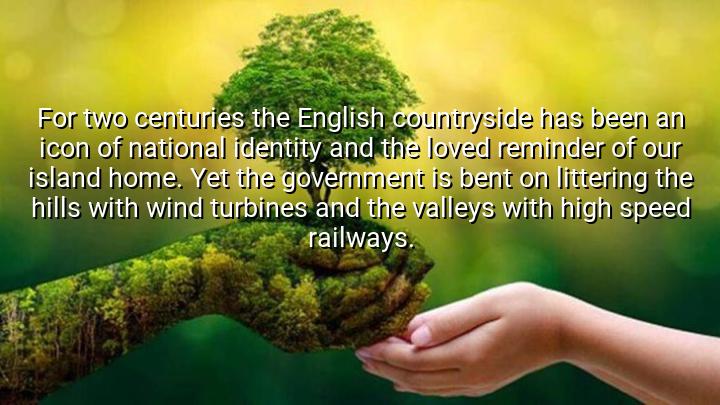




The quote by Roger Scruton, "For two centuries the English countryside has been an icon of national identity and the loved reminder of our island home. Yet the government is bent on littering the hills with wind turbines and the valleys with high-speed railways," reflects his concern about the preservation of England's countryside and the impact of modern development on the nation’s traditional landscape. Scruton is lamenting the encroachment of infrastructure projects like wind turbines and high-speed railways, which he views as detracting from the natural beauty and historical significance of the countryside. For Scruton, the English countryside has long been a symbol of national identity, and its alteration through such projects threatens the cultural and aesthetic value of the land.
Scruton’s statement underscores the tension between modernity and conservation. While environmental initiatives such as wind turbines may be designed to address climate change, Scruton argues that the imposition of these technologies can irreparably harm the visual appeal of rural landscapes that have been a central part of the nation’s identity for centuries. He is also critiquing the government's priorities, suggesting that the desire for progress and modern infrastructure may come at the expense of the country’s cherished heritage and natural beauty.
The origin of this quote comes from Roger Scruton, a British philosopher, writer, and conservative thinker. Known for his writings on aesthetics, culture, and conservatism, Scruton was a vocal advocate for the protection of traditional landscapes and values. He believed in the importance of preserving historical heritage, which he saw as a fundamental part of a nation’s identity. His concerns about modern development reflect his broader views on the balance between tradition and progress.
In essence, Scruton’s quote serves as a critique of modern development policies that prioritize infrastructure over the preservation of cultural heritage and natural beauty. His words emphasize the need for a balanced approach that respects both the environment and the historical significance of landscapes, advocating for a future that is mindful of the past while addressing contemporary needs.

AAdministratorAdministrator
Welcome, honored guests. Please leave a comment, we will respond soon