

The rewards for biotechnology are tremendous - to solve disease, eliminate poverty, age gracefully. It sounds so much cooler than Facebook.
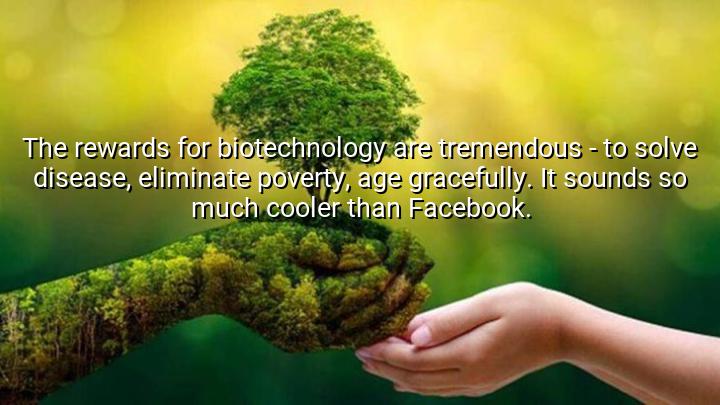




The quote, "The rewards for biotechnology are tremendous - to solve disease, eliminate poverty, age gracefully. It sounds so much cooler than Facebook," is from George M. Church, a renowned American biologist, geneticist, and professor. Church is a pioneer in the field of biotechnology and has made significant contributions to genomics and synthetic biology. In this quote, Church emphasizes the transformative potential of biotechnology to address some of humanity's most pressing challenges, such as disease, poverty, and the ability to age gracefully.
By highlighting the rewards for biotechnology, Church refers to the profound impact that breakthroughs in genetic engineering, medicine, and other biotechnological fields could have on human health and quality of life. The idea of solving long-standing problems, like curing diseases or eradicating poverty, underscores biotechnology’s potential to improve society on a global scale. He contrasts these monumental goals with the popular appeal of social media platforms like Facebook, suggesting that biotechnology's potential is not only more impactful but also more exciting and visionary.
Church's comparison between biotechnology and Facebook reflects his belief in the prioritization of innovation that can drive meaningful change. While social media platforms have undoubtedly revolutionized communication and social interaction, he points out that the stakes in biotechnology are far greater, with the ability to alter the very fabric of human existence. Biotechnology, in his view, offers solutions to life-threatening issues and enhances the human experience in ways that go beyond mere technological convenience.
In essence, Church’s quote is a call to recognize the immense potential of biotechnology, urging society to focus on innovations that can transform lives, cure diseases, and tackle global challenges. He stresses that while social media has its place, the future lies in fields that promise to improve the human condition on a much deeper and more lasting level.

TNTuyet Nguyen
This quote struck me as both hopeful and slightly cheeky. I love the optimism about aging gracefully and eradicating poverty—who wouldn’t want that? But the comparison to Facebook is more than a jab; it’s a reflection of how society sometimes glorifies entertainment over substance. What will it take for scientific innovation to get the same spotlight as social media? Maybe it’s not just about coolness, but about changing the narrative altogether.
UGUser Google
This made me think about the contrast between long-term societal value and short-term gratification. Social media often dominates the cultural narrative, but biotech has the power to genuinely shape our future. I appreciate the ambition here, but also feel cautious—progress in biotech raises ethical questions, especially around genetic engineering and access. Can we truly advance without compromising on moral or social equity?
NDHoang Ngoc Duc
The way this quote elevates biotechnology feels justified given the stakes—curing disease, combating poverty, and enhancing quality of life. But I’m curious: How close are we, really, to these breakthroughs? Sometimes it feels like biotech advances are overhyped or years away from reality. Is it responsible to make such bold claims, or does this kind of enthusiasm help attract the attention and funding the field desperately needs?
1N13.Huong Nguyen
As someone interested in both tech and science, I find this quote quite provocative. It draws a sharp line between meaningful innovation and superficial digital culture. But it also raises an important question: Are we doing enough to support the kind of science that tackles big problems? Or are we too distracted by apps and platforms that entertain more than they empower? I’d love to see more public excitement for biotech breakthroughs.
VKTran Viet Khang
I like the boldness of this quote. It’s refreshing to hear someone champion science with real-world benefits rather than just tech fads. But I also wonder—can biotechnology really eliminate poverty, or is that an overly optimistic view? Technology often needs equitable systems to have a true impact. So while the potential is there, the real challenge may be ensuring access and fairness across global communities.