

The real danger is not that computers will begin to think like men, but that men will begin to think like computers.
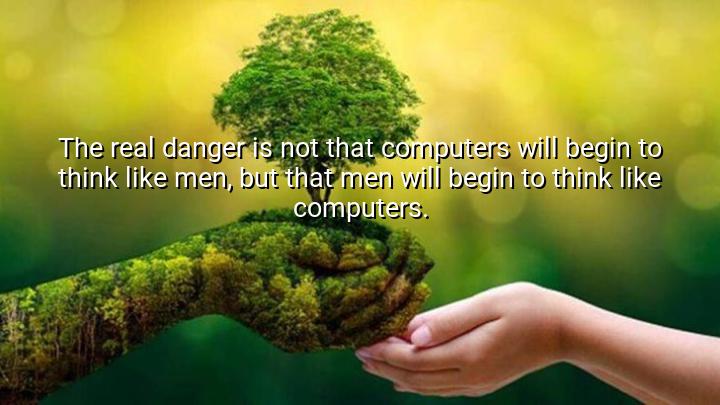




The quote "The real danger is not that computers will begin to think like men, but that men will begin to think like computers" by Sydney J. Harris explores the potential negative consequences of technological advancement on human behavior. Harris suggests that the true threat lies not in computers surpassing human intelligence, but in humans becoming overly influenced by the mechanical and algorithmic way computers process information. The quote highlights a concern that as people grow more dependent on technology, they may start to adopt a more rigid, logic-driven mindset, abandoning their creativity, empathy, and critical thinking.
The origin of this quote comes from a time when computers were becoming increasingly advanced, and the world was beginning to see their potential for transforming daily life. Harris, a journalist known for his insightful commentary, was reflecting on how humanity might evolve alongside the rise of artificial intelligence. Rather than fearing machines taking over, he feared a shift in human behavior that might lead people to mirror the cold, unemotional, and formulaic way in which computers function.
In a deeper sense, the quote also warns against the dehumanization that could occur if individuals start thinking in purely binary terms, focusing solely on efficiency and outcomes rather than the nuances of human experience. It speaks to the importance of maintaining the qualities that make us human, such as emotion, intuition, and moral reasoning, even as technology becomes more embedded in our lives.
Ultimately, Harris emphasizes that the real danger is the loss of human touch and individuality in the face of overwhelming technological influence. The fear is that humans might start to view the world through a lens of detachment, much like how a computer processes data, instead of appreciating the complexities of life that go beyond simple logic and calculation.

AAdministratorAdministrator
Welcome, honored guests. Please leave a comment, we will respond soon