

When I hear somebody sigh, 'Life is hard,' I am always tempted to ask, 'Compared to what?'
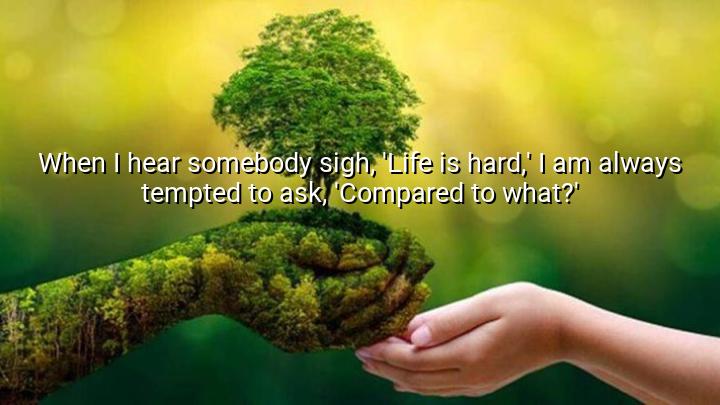




Sydney J. Harris’s quote, "When I hear somebody sigh, 'Life is hard,' I am always tempted to ask, 'Compared to what?'," challenges the common perception that life is particularly difficult or unfair. Harris is suggesting that many people tend to view their lives as more challenging than they actually are, without considering the relative nature of struggles or hardships. By asking "compared to what?", he invites people to reflect on their own circumstances and perspective, highlighting that what we often perceive as hardships might not be as severe when compared to other experiences or situations.
The quote implies that human suffering is often subjective, shaped by personal perspective and comparison to others. Harris seems to be questioning the tendency to focus on personal struggles without recognizing the broader context or the privileges one may have. It calls attention to the fact that, while life may feel difficult at times, the challenges we face can be viewed in a different light when we take into account the more extreme hardships others endure. This perspective encourages gratitude and a deeper sense of awareness about one’s own situation.
Furthermore, Harris’s remark critiques the tendency to focus on complaints without considering the relative advantages or comforts we may have. The question "Compared to what?" challenges the victim mentality, urging people to step back and reassess their situation with a more balanced or objective view. It suggests that, in many cases, perspective can significantly alter how we perceive difficulty, reminding us that hardships are often part of a bigger picture.
In essence, this quote serves as a reminder that life’s challenges, though real and valid, should be considered in context. Harris calls for greater self-reflection and perspective, urging people to evaluate their struggles not in isolation, but by comparing them to the broader spectrum of life’s experiences. It’s a call to move beyond a mindset of self-pity and towards one of gratitude and awareness.

AAdministratorAdministrator
Welcome, honored guests. Please leave a comment, we will respond soon