

The main failure of education is that it has not prepared people to comprehend matters concerning human destiny.
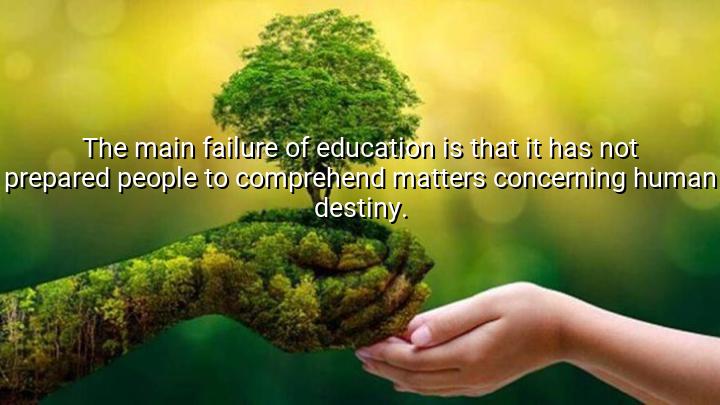




The quote "The main failure of education is that it has not prepared people to comprehend matters concerning human destiny." by Norman Cousins critiques the limitations of the traditional education system. Cousins, a prominent journalist, author, and peace advocate, suggests that while education systems may focus on imparting knowledge and practical skills, they often fall short when it comes to teaching students how to grapple with deeper, more existential questions related to human destiny and the broader purpose of life. This critique highlights a gap in education that, according to Cousins, leaves individuals unprepared for understanding the larger, more profound aspects of existence.
Originating from Norman Cousins, this quote reflects his belief that true education should encompass more than just technical or vocational knowledge—it should also address philosophical, ethical, and spiritual questions about humanity’s place in the world. Cousins was deeply involved in promoting peace, human rights, and social justice, and he argued that education should also equip individuals with the tools to understand and navigate complex issues about human life and destiny. For him, education should foster an understanding of the broader human condition, including our roles in shaping the future.
Cousins' perspective suggests that education as it is traditionally structured often focuses narrowly on subjects like mathematics, science, or history, but does not always encourage students to think critically about the bigger picture. The failure, in his view, is not in the quantity of knowledge provided, but in the quality and the depth of understanding related to the questions of life’s purpose and meaning. He argues that the inability to address these matters leaves a gap in the human experience that can hinder personal growth and societal progress.
Ultimately, Cousins' quote is a call for a more holistic approach to education—one that not only teaches practical skills but also fosters a deeper comprehension of humanity’s place in the world and the ethical responsibilities that come with understanding our destiny. It challenges the traditional view of education as purely academic and calls for a broader, more integrated approach that prepares individuals to think deeply about the future of humanity and their role in it.

AAdministratorAdministrator
Welcome, honored guests. Please leave a comment, we will respond soon