

The human body experiences a powerful gravitational pull in the direction of hope. That is why the patient's hopes are the physician's secret weapon. They are the hidden ingredients in any prescription.
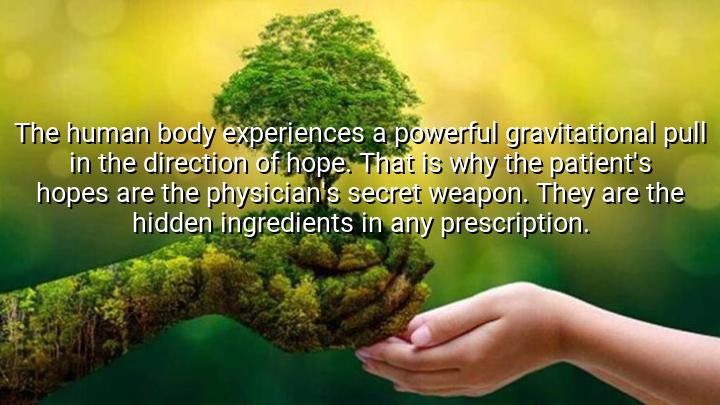




Norman Cousins' quote, "The human body experiences a powerful gravitational pull in the direction of hope. That is why the patient's hopes are the physician's secret weapon. They are the hidden ingredients in any prescription," speaks to the profound impact that hope and positive thinking can have on healing and recovery. Cousins, a journalist and advocate for the mind-body connection, suggests that the mind plays a crucial role in physical health. He emphasizes that hope is not just an emotional or psychological state but something that can physically influence the body, acting as a force that propels the individual toward well-being.
The "gravitational pull" metaphor in the quote illustrates how hope can draw the body toward recovery, much like gravity pulls objects toward the earth. Cousins implies that when a patient holds onto hope, it creates a powerful, positive force that aids in the healing process. This aligns with the growing field of psychoneuroimmunology, which studies the connection between the mind, nervous system, and immune response, showing how hope and positive emotions can bolster the body’s ability to fight illness.
Cousins also highlights the important role of the physician in nurturing this hope. He suggests that a physician’s ability to instill and support hope in a patient can be as critical as the physical treatments or prescriptions they provide. The “hidden ingredients” refer to the psychological aspects of care—such as encouragement, belief in recovery, and fostering a hopeful outlook—that are just as essential to healing as medical interventions.
In essence, Cousins’ quote underscores the power of the mind-body connection, proposing that hope is a vital component of the healing process. It reflects the idea that while medical treatments are important, the emotional and psychological state of a patient—particularly their hope—can have a significant impact on their recovery. The physician’s role is not only to treat the body but also to nurture the patient’s mental and emotional well-being, helping them harness the power of hope as part of their healing journey.

AAdministratorAdministrator
Welcome, honored guests. Please leave a comment, we will respond soon