

The changes in our life must come from the impossibility to live otherwise than according to the demands of our conscience not from our mental resolution to try a new form of life.
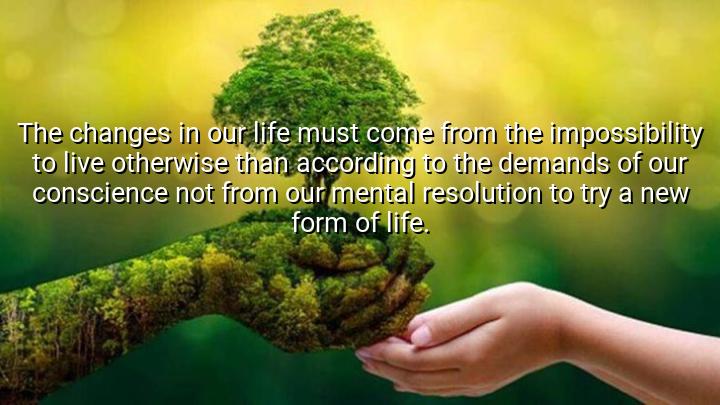




The quote "The changes in our life must come from the impossibility to live otherwise than according to the demands of our conscience, not from our mental resolution to try a new form of life" is attributed to Leo Tolstoy, the renowned Russian novelist and philosopher best known for works like War and Peace and Anna Karenina. In his later years, Tolstoy became deeply engaged in spiritual and ethical philosophy, focusing on themes such as moral responsibility, authenticity, and inner transformation. This quote reflects his belief in conscience as the true driver of meaningful life change.
Tolstoy argues that genuine transformation cannot be forced through mere willpower or intellectual decision-making. Instead, real change arises when living in any way other than in harmony with one’s conscience becomes intolerable. This suggests that moral and spiritual growth stems not from external pressures or abstract goals, but from an urgent inner need to live truthfully and with integrity. For Tolstoy, conscience is not optional—it is the foundation of an authentic life.
The contrast he draws between mental resolution and the demands of conscience is profound. While mental resolutions may inspire short-term efforts or lifestyle experiments, they often lack the deep emotional or spiritual urgency required for lasting change. Conscience, by contrast, speaks from a deeper place—pressuring the individual to align their life with higher ethical or spiritual truths. This view emphasizes sincerity and moral clarity over superficial or performative efforts at self-improvement.
Ultimately, Tolstoy’s quote is a call to embrace inner truth as the basis for life decisions. It warns against making changes merely to follow trends or ideas, and instead urges us to listen to the voice within—to the moral compass that guides us toward what is right, even when it is difficult. In doing so, we find not just a new way of living, but a necessary and authentic one.

AAdministratorAdministrator
Welcome, honored guests. Please leave a comment, we will respond soon