

The arrogance of age must submit to be taught by youth.
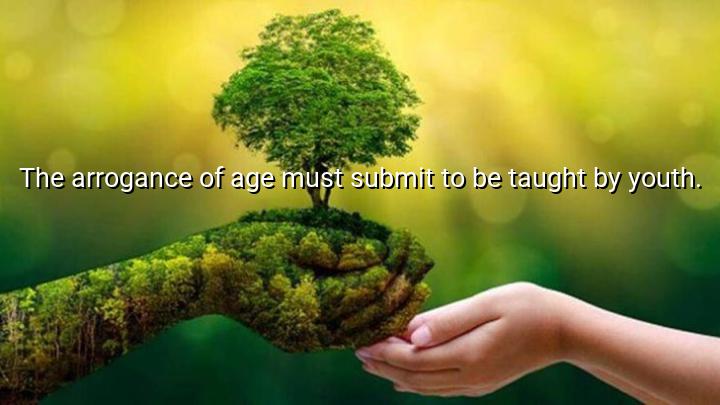




In this quote, Edmund Burke highlights the intergenerational dynamic between age and youth. He suggests that the arrogance of age, which can often manifest as stubbornness, pride, or a belief in the superiority of experience, must submit or give way to the fresh perspectives and ideas of youth. Burke implies that even those who are older and more experienced have something to learn from younger generations, who often bring new ways of thinking and fresh energy to challenges.
Burke's statement challenges the common belief that age and experience are the ultimate sources of wisdom and that older individuals should always be the ones to impart knowledge. Instead, he proposes that there is value in the innovation, creativity, and idealism that youth can offer, especially in times of change. In this way, the wisdom of the older generation must sometimes make room for the vision of the younger generation.
This idea is rooted in the belief that progress and growth often come from a balance of tradition and innovation. While experience is valuable, it should not hinder the incorporation of new ideas or the willingness to adapt to evolving circumstances. Burke's quote speaks to the necessity of mutual respect and the importance of being open to learning from others, regardless of their age.
Ultimately, Edmund Burke's quote suggests that in order for societies and individuals to grow, there must be a humility in age and a willingness to be influenced and taught by the energy and perspective of youth. It encourages cross-generational dialogue and highlights the idea that knowledge and wisdom can come from many different sources, including those who are younger.

HTNguyen Hieu Thuan
This quote makes me think about movements led by young people—climate change protests, digital activism, social justice initiatives. Youth are often the first to call out outdated norms, but are they being heard enough? I wonder what it would take for institutions led by older people to actively seek out youthful perspectives. Would you say we’re getting better at this as a society, or is age still a barrier to being taken seriously?
ZZZhenYuan Zhang
I’m torn on this quote. On one hand, it empowers youth, which is refreshing. On the other hand, it risks dismissing the value of lived experience. Shouldn’t the ideal be a dialogue between generations, not a submission from one to the other? I’m curious—do you think the arrogance of youth is equally dangerous? Or is this more about breaking the tradition of automatically associating age with infallibility?
ONoanh nguyen
Isn’t it ironic that we often teach children to respect their elders, but we rarely teach elders to learn from the young? I think Burke was way ahead of his time in expressing this. What examples in modern society show this dynamic in action—either positively or negatively? I’d love to know if this quote could help bridge some of the generational gaps we see in politics, education, or even the workplace.
NNNga Nguyen
As someone who’s been both a student and a mentor, this quote challenges me. How often do we truly listen to younger voices, especially when we think we 'know better'? There’s a vulnerability in being older and admitting someone younger might have a better perspective. But isn’t growth supposed to be a lifelong process? I wonder if our resistance to learning from youth comes from insecurity more than genuine belief in superiority.
NLNguyen Ngoc Linh
I’m intrigued by the suggestion that age brings not only wisdom but also arrogance. It’s a powerful reversal of the typical narrative. Do you think older generations are often too set in their ways to learn from the young? Or is it more about mutual respect needing to go both ways—youth respecting age’s experience, and age respecting youth’s fresh insights? Either way, I think humility might be the key ingredient here.