

The age we live in is a busy age; in which knowledge is rapidly advancing towards perfection.
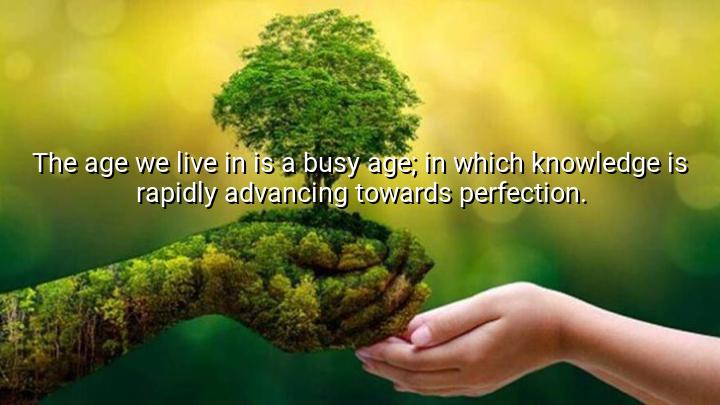




Jeremy Bentham’s quote, "The age we live in is a busy age; in which knowledge is rapidly advancing towards perfection," reflects his recognition of the intense pace of societal and intellectual progress during his time. He describes an era filled with constant activity and a growing demand for information and understanding, indicating that knowledge is evolving at an unprecedented rate.
The quote highlights the rapid advancement of knowledge, suggesting that we are in an age where discoveries and innovations are happening faster than ever before. This growth is not merely incremental but is pushing towards perfection, as new ideas, technologies, and solutions continuously refine and improve our understanding of the world.
Bentham, a prominent philosopher and social reformer, made this observation during the late 18th and early 19th centuries, a period marked by significant intellectual and industrial progress. During this time, philosophy, science, and technology were making monumental leaps, laying the groundwork for the modern world.
The origin of this thought can be seen as Bentham's reflection on the industrial revolution and the enlightenment ideals of rationality and progress. His quote serves as a reminder that with the growing complexity of the world, knowledge is becoming both more intricate and more valuable, and this advancement is transforming society in ways that might lead to greater perfection in human life.

TPThanh Pham
Reading this makes me think about the personal impact of living in such a fast-paced, knowledge-driven era. How do individuals keep up without feeling overwhelmed? What strategies can help us manage information overload and still contribute meaningfully to the ongoing pursuit of knowledge? Is slowing down sometimes necessary to move forward effectively?
TKGia Thien Kieu
I like the hopeful tone here about knowledge moving toward perfection, yet I can’t help but question the idea of perfection in knowledge. Is it ever really possible, or is knowledge always evolving and provisional? How might embracing uncertainty and continuous learning shape our approach to education and innovation in this busy age?
NHnguyen hanh
This quote highlights the remarkable speed at which knowledge evolves, which is exciting. But I’m curious about who benefits most from this progress. Is this rapid advancement equally accessible across different societies and communities, or does it deepen existing inequalities? What responsibilities do knowledge creators have in making their work inclusive and relevant?
Aaduongnguyen
Bentham’s view of our age as busy and knowledge-driven resonates strongly today. I wonder, though, does the rapid advancement of knowledge always translate to better understanding or improved quality of life? Are there risks that the speed of progress might outpace ethical considerations or social adaptation? How do we ensure wisdom keeps pace with knowledge?
HNHuy Nguyen
This quote feels both optimistic and a bit daunting. The idea that knowledge is advancing rapidly toward perfection sounds inspiring, but is perfection really attainable? In an age overflowing with information, how do we discern useful knowledge from noise? Could this rapid pace lead to burnout or overwhelm, and how can society balance progress with thoughtful reflection?