

The said truth is that it is the greatest happiness of the greatest number that is the measure of right and wrong.
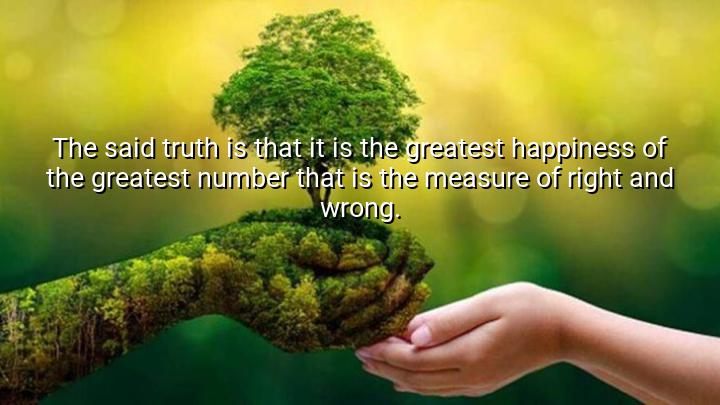




The quote by Jeremy Bentham, "The said truth is that it is the greatest happiness of the greatest number that is the measure of right and wrong," embodies the principle of utilitarianism, a moral philosophy developed by Bentham. According to this view, the right or wrong of an action is determined by its consequences, specifically whether it promotes the greatest happiness for the greatest number of people. This approach prioritizes the collective well-being over individual interests, suggesting that the moral value of an action should be measured by its ability to maximize overall happiness and reduce suffering.
Bentham’s idea challenges traditional moral frameworks by offering a consequentialist approach to ethics. Unlike deontological theories, which focus on duties and rules, utilitarianism assesses actions based on their outcomes. This means that if an action leads to a greater balance of happiness for a larger group, it is deemed morally right, while actions that cause harm or reduce happiness are considered wrong. The emphasis on the greatest number reflects Bentham’s belief in democracy and the importance of social welfare.
In this context, the quote encourages a pragmatic approach to decision-making, where the focus is on practical outcomes that benefit the majority. Bentham’s utilitarianism influenced social and political thought, particularly in areas such as law, economics, and public policy, where decisions are often made based on the greater good. It advocates for policies that aim to improve the quality of life for as many people as possible, while minimizing harm and suffering.
In essence, Bentham’s quote highlights the central tenet of utilitarianism: that the moral worth of an action is determined by its ability to promote happiness for the largest number of people. It suggests that ethical decisions should be made with the well-being of the broader society in mind, advocating for a balance between individual rights and collective good in shaping moral and social practices.

AAdministratorAdministrator
Welcome, honored guests. Please leave a comment, we will respond soon