

The age of innocent faith in science and technology may be over.
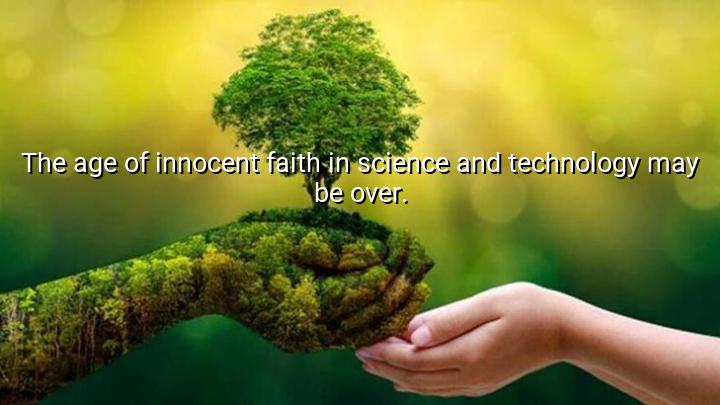




In this quote, Barry Commoner, an American biologist and environmentalist, reflects on the evolving relationship between society and science and technology. He suggests that the period of innocent faith—a time when people blindly trusted that science and technology would solve all problems—is coming to an end. Commoner points out that, as we have seen the negative consequences of unchecked technological advancement and environmental degradation, people are beginning to question the unchecked optimism that once surrounded scientific progress.
The age of innocent faith refers to a time when new technologies and scientific discoveries were often celebrated without considering their long-term impacts. People were led to believe that science and technology could solve all problems and improve life in every possible way. However, as issues such as pollution, climate change, and the ethical implications of new technologies have emerged, public trust in the infallibility of science has diminished. Commoner’s quote highlights a shift toward more critical thinking about the role of science and technology in society.
The origin of this quote is rooted in Commoner’s career as an environmentalist, where he often spoke out against the harmful effects of industrialization and technological progress. As someone deeply concerned about the environment, Commoner was critical of the way in which science and technology were being used to exploit natural resources without fully considering their consequences. His advocacy for sustainable development and ecological responsibility shaped his views on the limitations of scientific advancements.
Ultimately, Commoner’s statement suggests a paradigm shift in how society views the relationship between technology and the environment. The "innocent faith" that science and technology would lead to universal progress is being replaced with a more skeptical and responsible approach, acknowledging the potential risks and unintended consequences of technological development. His words remind us to balance innovation with thoughtful consideration of its long-term effects.

CVCao Vy
I’m curious—what would it take to restore some level of faith in science and technology? Is it even possible without radical transparency and public involvement? I don't think losing blind trust is inherently bad, but the vacuum it creates can be filled with misinformation. Maybe the issue isn’t that science failed us, but that we failed to create systems that align innovation with human values.
UGUser Google
This quote hits differently in an age of AI, genetic editing, and climate change. Have we moved past the point where innovation feels purely exciting? Now, every new breakthrough seems to carry a shadow—an unintended consequence, a moral cost. It makes me think: should scientific advancement come with built-in ethical education? Can we trust institutions to self-regulate in a world driven by profit?
Vvanthientoan
Honestly, I think the erosion of trust in science and tech is both understandable and dangerous. On one hand, corporate misuse, environmental damage, and ethical breaches have made us wary. On the other, this mistrust fuels conspiracy theories and anti-science rhetoric. How do we balance skepticism with the need to keep believing in progress and discovery? It feels like we’re walking a very thin line.
ADAnh duy
I wonder if this statement is actually hopeful in disguise. Maybe the end of 'innocent faith' just means we're growing up as a society—learning to question, challenge, and scrutinize what we once took for granted. That might be exactly what science needs: not less faith, but smarter engagement. What does it look like to be both critically aware and still inspired by scientific progress?
CMHoang Cong Minh
This quote makes me reflect on how we've shifted from embracing science as a universal good to becoming deeply skeptical of its consequences. From environmental disasters to data privacy concerns, technology has shown its darker sides. But is it fair to lose faith entirely, or should we be developing a more mature, informed trust that includes accountability? Blind faith may be gone, but thoughtful vigilance might be a better replacement.