

The wave of new productive enterprises would provide opportunities to remedy the unjust distribution of environmental hazards among economic classes and racial and ethnic communities.
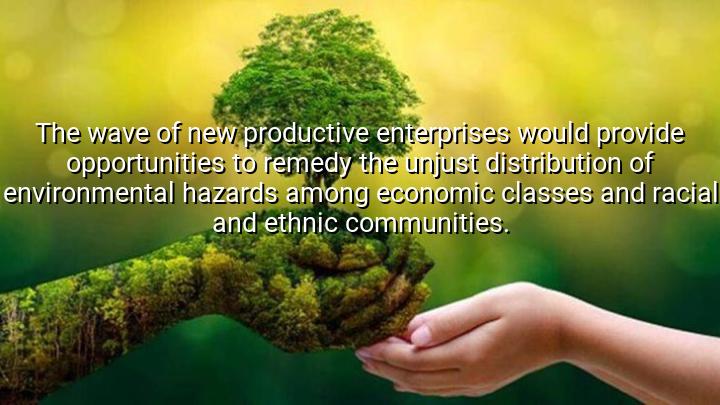




The quote by Barry Commoner emphasizes the potential of new productive enterprises to address environmental justice. Commoner suggests that emerging industries and technologies can create opportunities to correct the unequal distribution of environmental hazards, which disproportionately affect certain economic classes and racial and ethnic communities. This highlights the connection between economic development and the equitable management of environmental risks.
By focusing on the unjust distribution of environmental hazards, Commoner points out that pollution, toxic waste, and other environmental risks are often not shared evenly across society. Poorer communities and marginalized groups frequently bear the heaviest environmental burdens, a situation that reinforces social and economic inequalities. The quote implies that thoughtful economic planning can help redress these imbalances.
The origin of the quote comes from Commoner’s work as a pioneering environmental scientist and activist, particularly his advocacy for socially responsible environmental policies. He consistently argued that technological innovation and the creation of new productive enterprises should be aligned with social equity, ensuring that all communities benefit from progress while minimizing harm.
Overall, the quote conveys a message about the intersection of environmental protection, social justice, and economic development. It encourages policymakers and society to leverage innovation and enterprise not only for economic growth but also to promote fairness and equity, ensuring that environmental risks do not disproportionately burden disadvantaged groups.

AAdministratorAdministrator
Welcome, honored guests. Please leave a comment, we will respond soon