

Poetry is the universal language which the heart holds with nature and itself. He who has a contempt for poetry, cannot have much respect for himself, or for anything else.
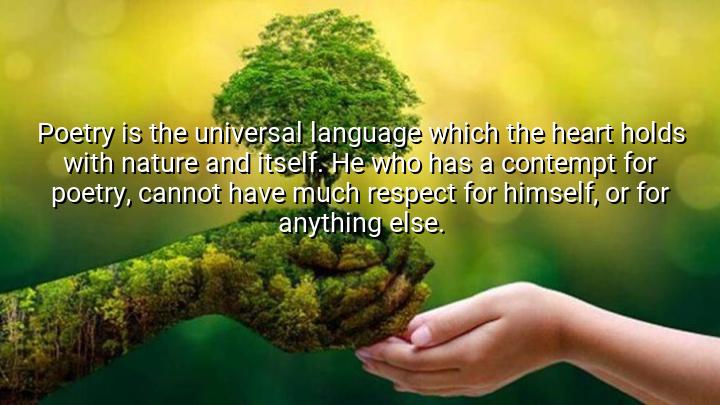




This quote by William Hazlitt reflects his deep belief in the power and universality of poetry. By describing it as the universal language, Hazlitt suggests that poetry transcends cultural and linguistic barriers, speaking directly to the heart and connecting human beings with nature as well as with their own inner emotions. In this view, poetry is not just a form of art, but a natural expression of human experience and feeling.
Hazlitt emphasizes that to dismiss or hold contempt for poetry is to reject a fundamental part of what it means to be human. Since poetry embodies imagination, emotion, and reflection, rejecting it implies a lack of respect not only for art but also for oneself and for the deeper values of life. For Hazlitt, appreciation of poetry is tied to sensitivity, empathy, and the ability to see beauty and meaning in existence.
The origin of this idea is rooted in Hazlitt’s career as a Romantic-era essayist and critic. Living during a period when literature and philosophy were centered on emotion, individuality, and the connection between humanity and nature, Hazlitt was deeply influenced by Romantic thinkers like Wordsworth and Coleridge. His writings often defended the importance of imagination and creativity against the rising tide of industrial and utilitarian values in his time.
Ultimately, Hazlitt’s quote serves as both a defense and a celebration of poetry. It reminds us that engaging with poetic expression is not a luxury but a vital part of understanding ourselves and the world around us. To disregard poetry, in Hazlitt’s eyes, is to disregard the essence of what makes us human—our capacity for feeling, wonder, and profound connection.

AAdministratorAdministrator
Welcome, honored guests. Please leave a comment, we will respond soon