

People return home from prison and face legal discrimination in virtually all areas of social and economic and political life. They are legally discriminated against employment, barred from public housing, and denied other public benefits.
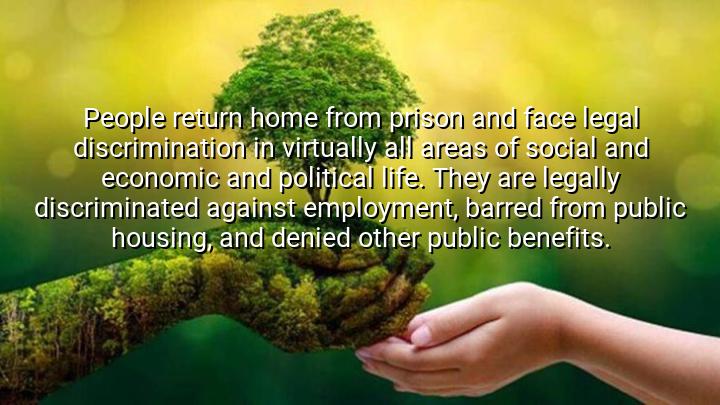




Michelle Alexander’s quote sheds light on the systemic legal discrimination faced by individuals who return home from prison. She points out that these individuals are often subjected to discrimination across various areas of life, including employment, public housing, and access to public benefits. Alexander emphasizes that even after serving their sentences, formerly incarcerated individuals continue to face significant barriers that hinder their ability to fully reintegrate into society and achieve economic stability. This creates a cycle of disadvantage that often leads to recidivism, as they are excluded from essential resources needed for successful reentry.
The quote also highlights the broader issue of what Alexander calls the New Jim Crow, where the criminal justice system disproportionately targets people of color, especially Black men. The legal stigmatization that follows incarceration prevents these individuals from enjoying the same rights and opportunities as others, essentially rendering them as second-class citizens. By pointing out the denial of public benefits, Alexander stresses how these policies not only limit their economic opportunities but also affect their ability to participate fully in society and democracy.
Alexander’s words reflect her deep concern for the criminal justice system and the way it perpetuates racial and social inequality. Her work, particularly her influential book The New Jim Crow, argues that mass incarceration functions as a racial caste system in the United States. By detailing the continued legal obstacles faced by formerly incarcerated people, she calls attention to the need for reform in the way the criminal justice system treats those who have served their time.
The origin of this quote comes from Alexander’s extensive research and advocacy around issues of mass incarceration and racial inequality. As a civil rights lawyer and author, she has spent years working to raise awareness about the injustices that individuals face after being released from prison. Through her writings, she encourages a broader conversation about the legal and social systems that contribute to the marginalization of millions of formerly incarcerated people in the United States.

AAdministratorAdministrator
Welcome, honored guests. Please leave a comment, we will respond soon