

Ours is an age of pedagogy. Anxious parents instruct their children more and more, at younger and younger ages, until they're reading books to babies in the womb.
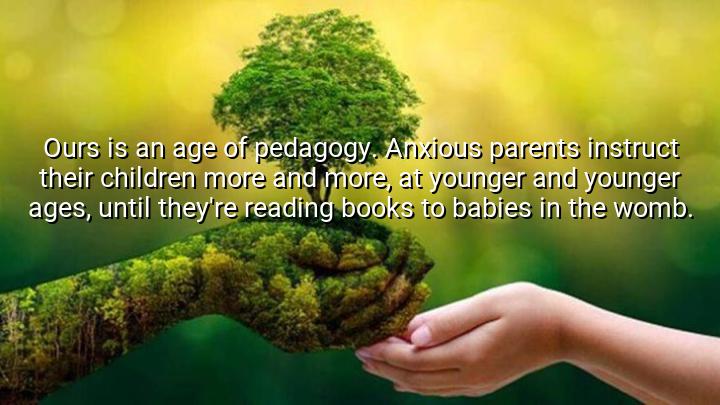




Alison Gopnik’s quote critiques the modern obsession with early education and the growing trend of pedagogy in today’s society. She points out that parents are increasingly anxious about their children's development and feel the need to begin instruction at younger and younger ages. The image of reading books to babies in the womb serves as an exaggerated but telling example of how this drive to educate has gone to extreme lengths. Gopnik is highlighting the pressure placed on parents to prepare their children for the future by introducing education before birth, a phenomenon that reflects societal fears about falling behind or not doing enough for their children's success.
The phrase "age of pedagogy" suggests that we are living in a time where education and teaching are central, but not necessarily in the most beneficial or thoughtful ways. Gopnik’s use of pedagogy refers to the methods and practices of teaching, but her choice of words implies that these practices are becoming more about fulfilling social expectations than about fostering genuine learning or creativity. Parents, rather than allowing their children to develop at their own pace, are pushed by societal pressures to be overly involved in their children's early intellectual life.
Gopnik’s statement also critiques the increasing anxiety around parenting and child development. The idea that parents are pushing their children to achieve milestones earlier than ever suggests a deep fear that they might not be doing enough or that their children might be missing out on an early advantage. This reflects a shift from nurturing a child’s natural growth and exploration toward an emphasis on early academic achievement.
Ultimately, Gopnik’s quote highlights the paradox of the modern era: the more we focus on instruction and teaching at earlier ages, the more we may undermine the natural development and curiosity of children. It serves as a reminder to question whether early education and extreme involvement are truly beneficial or if they are simply a response to societal pressures that fail to acknowledge the importance of play, imagination, and self-discovery in childhood development.

NANguyen An
I found this quote both amusing and sobering. It perfectly captures how parenting has become a kind of arms race. But what are we losing in the process? Is spontaneity, imagination, and boredom—once key parts of childhood—now seen as wastes of time? I worry that in trying to engineer perfect learners, we might be undermining resilience and emotional richness.
THChu Thi Thu Hang
This quote makes me think about the difference between exposure and pressure. Reading to kids is great, but when it’s rooted in anxiety, it stops being nurturing and starts feeling transactional. Are we raising children who are constantly evaluated rather than simply loved? I wonder how much of this stems from societal expectations and competition among parents, rather than genuine developmental needs.
TDKim Thoa Doan
I appreciate the subtle critique in this quote. It’s not just about reading to babies—it’s about a culture that views childhood as a race. Are we so afraid of falling behind that we forget how learning actually works? I’d love to know how Gopnik thinks this trend impacts children later in life. Does it help them thrive, or just burn out sooner?
TTNguyen Thi thanh
Alison Gopnik’s observation feels both insightful and slightly alarming. It makes me wonder: when did parenting shift from nurturing to performance? Are we mistaking early instruction for long-term development? There’s something almost absurd about reading to babies in the womb—not because it’s harmful, but because it reveals how anxious we’ve become about giving our children a ‘head start.’ Where’s the line between thoughtful engagement and over-parenting?
GMDang ga mo
This quote really made me pause. It’s true—we’ve become obsessed with optimizing childhood, as if learning has to be squeezed into every possible moment. But is this kind of over-instruction actually beneficial, or does it stifle creativity and natural exploration? I wonder if today’s parenting culture is more about managing fear than fostering genuine curiosity in kids. Are we teaching too much, too soon?