

Young children seem to be learning who to share this toy with and figure out how it works, while adolescents seem to be exploring some very deep and profound questions: 'How should this society work? How should relationships among people work?' The exploration is: 'Who am I, what am I doing?'
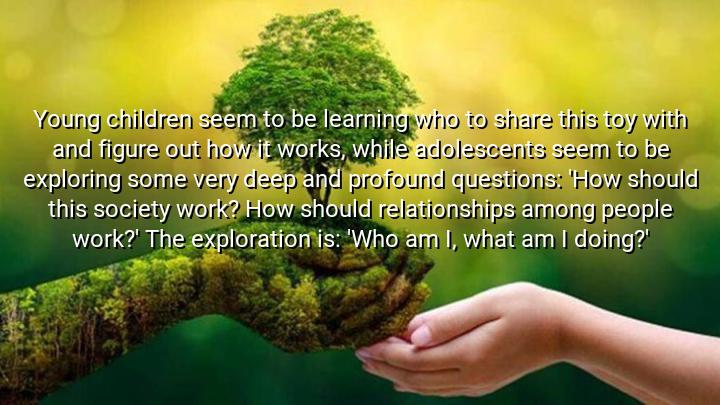




In this quote, Alison Gopnik, a developmental psychologist, contrasts the different stages of learning in young children and adolescents. She suggests that while young children are focused on sharing and learning how things work, adolescents are engaged in deeper, more existential questions about society and relationships. Gopnik highlights the developmental shift between the concrete learning of childhood and the more abstract, introspective exploration of adolescence.
Gopnik’s mention of children learning "who to share this toy with" illustrates their early understanding of social interactions and basic principles of cooperation. As they mature, adolescents begin to shift focus toward larger questions such as "How should this society work?" and "How should relationships among people work?" These are the foundational questions of identity and social responsibility that shape their understanding of the world.
The origin of this quote comes from Gopnik’s research on child development, where she has explored how children’s minds evolve as they grow older. She is well-known for her work on how children learn about the world, particularly through play and interaction with others. Her research has shown that as children age, they start to engage more deeply with their social and personal identities, moving from a focus on the immediate world to broader questions about how they fit into society.
Ultimately, Gopnik’s quote highlights the progression of human development, showing how individuals move from learning practical skills to grappling with profound questions about their role in the world. It emphasizes that adolescence is a time of profound personal and social exploration, where young people begin to seek meaning in their lives and the larger structures of society.

AAdministratorAdministrator
Welcome, honored guests. Please leave a comment, we will respond soon