

Only by keeping oneself in constant process of growth, under the constant influence of the best things in one's own age, does one become a companion halfway good enough for one's children.
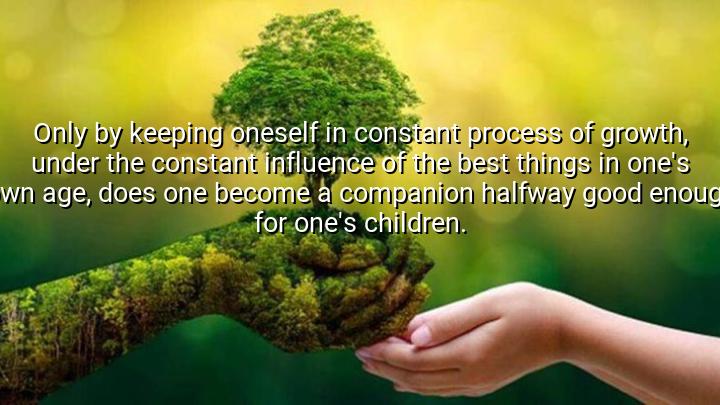




Ellen Key’s quote emphasizes the importance of personal growth and the need for individuals to continually evolve throughout their lives. She suggests that in order to be a good companion for one’s children, a person must remain engaged in a process of growth that is influenced by the best things of their time. This implies that staying connected to the most progressive ideas, cultural movements, and values of one's era is essential for being a relevant and meaningful figure in the lives of future generations.
Key highlights the idea that growth isn’t just a personal journey but also something that makes one a more valuable and engaged parent. By being open to learning, adapting, and evolving with the times, a person becomes better equipped to guide and support their children in ways that are relevant to the world they are growing up in. This is contrasted with stagnation, where outdated beliefs or practices can lead to a disconnect between generations.
The phrase "under the constant influence of the best things in one's own age" suggests that an individual should not only pursue growth for growth’s sake but should also be receptive to the positive influences of the present. This could include embracing education, innovation, and culture that align with the values of the time. Key is advocating for a forward-thinking mindset, one that recognizes the importance of staying current while fostering the ability to pass down wisdom to the next generation.
Ultimately, Key’s quote underscores the belief that in order to be a truly effective and wise guide for children, a parent or mentor must be continuously evolving. The process of growth in a person’s life makes them better suited to help their children navigate the complexities of their own world, providing guidance that is both timely and meaningful.

D9tran dung 9g
I think this quote is especially relevant now, with technology and social norms changing so quickly. Parents can feel left behind. But instead of seeing that as a threat, maybe it’s an invitation to evolve, to remain curious and engaged. Can society do more to support adults in this kind of ongoing development—not just for career or self-help, but for the sake of our families?
TTam
Key’s words suggest that relevance as a parent isn’t guaranteed by love alone—it requires intentional effort to grow. But that raises a question: who decides what the ‘best things’ of an age are? With so much noise in the modern world, how do you filter through trends and ideologies to focus on what truly enriches your ability to connect with your children?
MHVu Minh Hiep
This quote hits me because it challenges the generational gap that so often isolates parents and children. Instead of resisting change, it’s about engaging with it to meet your kids where they are. But I wonder—what does it look like practically to stay under the 'influence of the best things in one's age'? Is it about culture, technology, values, or something deeper?
TTim
I love the idea that self-growth isn’t just personal—it’s relational, especially in parenting. This makes me ask: are we modeling the kind of curiosity, openness, and adaptability we hope to see in our kids? Maybe being a ‘companion’ isn’t about having all the answers but being willing to grow alongside them. That feels like a radical but comforting redefinition of what it means to be a parent.
ECElite Cubi
There’s something humbling about this quote. It implies that we’re never quite 'good enough' for our children unless we’re constantly evolving. But doesn’t that also create pressure? What if someone feels overwhelmed by the pace of change or out of touch with modern culture? I think the deeper message might be about showing your kids that growth is a lifelong pursuit, not a finished product.