

No advance in wealth, no softening of manners, no reform or revolution has ever brought human equality a millimeter nearer.
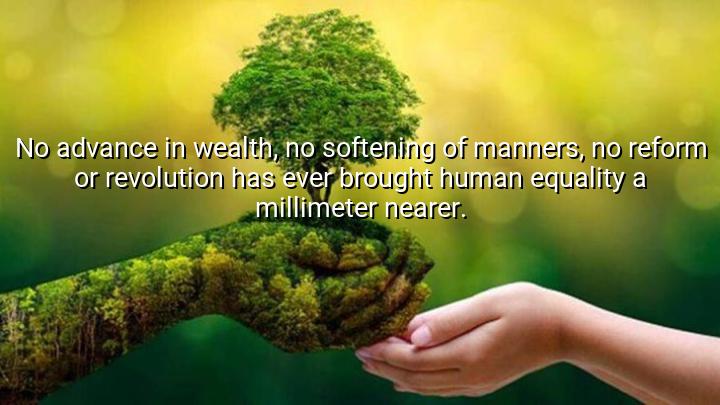




George Orwell’s quote, "No advance in wealth, no softening of manners, no reform or revolution has ever brought human equality a millimeter nearer," conveys his skepticism about the ability of economic progress, social reforms, or even revolutions to achieve true equality among humans. Orwell suggests that, despite changes in wealth distribution, societal attitudes, or political systems, the fundamental inequality between people—whether based on class, race, or power—remains largely unchanged. His statement critiques the belief that economic and social transformations can solve the deep-rooted inequalities that persist in human society.
In this context, Orwell is highlighting the limits of material progress and social reforms in addressing the structural issues that perpetuate inequality. While these changes may improve living conditions or make societies more civilized and compassionate, they don’t necessarily lead to a true leveling of the playing field. Orwell’s cynicism stems from his belief that hierarchies and power imbalances are deeply ingrained in human nature and social systems, making them resistant to superficial reforms.
The origin of this quote is tied to Orwell’s broader worldview, which was shaped by his experiences with totalitarianism, class struggles, and political idealism. Orwell, known for his works like "Animal Farm" and "1984", frequently critiqued both capitalist and communist ideologies for their failure to deliver on promises of equality and justice. In this quote, he expresses his concern that revolutions—despite their revolutionary rhetoric—often replace one form of oppression with another, without addressing the root causes of inequality.
Ultimately, Orwell’s statement serves as a warning about the limitations of political and social change in creating genuine equality. He encourages a deeper reflection on the nature of power and inequality, suggesting that superficial changes in wealth or manners are insufficient to address the profound disparities that exist between individuals and groups in society.

AAdministratorAdministrator
Welcome, honored guests. Please leave a comment, we will respond soon