

To an ordinary human being, love means nothing if it does not mean loving some people more than others.
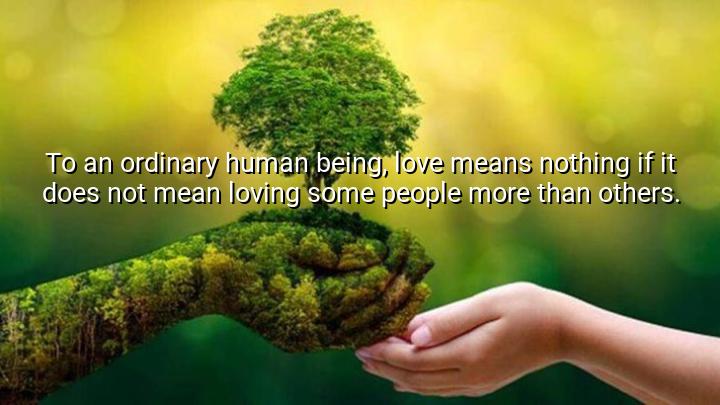




The quote “To an ordinary human being, love means nothing if it does not mean loving some people more than others” by George Orwell explores the subjective nature of love and its connection to human priorities. Orwell suggests that for love to have true meaning, it must be directed toward specific individuals, rather than being a universal or indiscriminate feeling. In other words, love becomes significant when it creates hierarchies or distinctions in the people we care about, prioritizing certain relationships over others. Without these preferences, love may feel vague or impersonal.
The origin of this quote is rooted in Orwell’s broader ideas about human nature and social dynamics. Orwell, an English novelist and essayist, is best known for his works 1984 and Animal Farm, in which he critiques totalitarianism, social injustice, and the complexities of human emotions. While Orwell often examined the dangers of collective thought and authoritarian control, he also had a nuanced understanding of how individual relationships shape our moral and emotional lives. This quote reflects his belief that love, in its truest form, is a deeply personal and selective emotion.
Orwell’s statement emphasizes the essential human tendency to form attachments and priorities. For love to feel genuine or real, it cannot be a generalized emotion; it must be focused on those we choose to value the most. This is a recognition of the complexity of human relationships and the psychological necessity of choosing whom to love more deeply. To love everyone equally, Orwell argues, would dilute the intensity and specificity of love, making it an abstract or meaningless concept.
In a broader sense, Orwell’s quote points to the contradiction between ideals of universal love and the practical reality that we naturally prefer some people over others. It suggests that the emotional richness of love lies in the distinctions we make between individuals, a fundamental part of what makes human connection meaningful. Thus, love is not simply a feeling of care, but a selective act, one that involves choosing who matters most to us.
Let me know if you need a shorter version or additional details!

AAdministratorAdministrator
Welcome, honored guests. Please leave a comment, we will respond soon