

Man has no Body distinct from his Soul; for that called Body is a portion of Soul discerned by the five Senses, the chief inlets of Soul in this age.
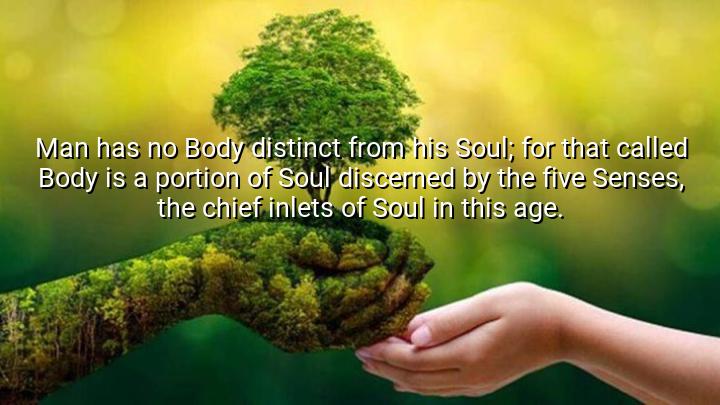




In this quote, William Blake presents a philosophical and spiritual perspective on the relationship between body and soul. He suggests that the body is not separate from the soul but is, in fact, a physical manifestation of the soul. Blake argues that the body is merely a part of the soul that can be perceived through the five senses, which are the primary ways we experience the world in this material age. This view challenges the traditional dualistic separation between the physical and spiritual realms, proposing instead that they are interconnected.
Blake’s statement implies that what we perceive as our physical form—the body—is not distinct from our spiritual essence. The body, in his view, is a vehicle for the soul, allowing it to interact with the material world. The senses, such as sight, touch, and taste, act as conduits for the soul to experience the world and to express itself. This perspective emphasizes the unity of mind, body, and spirit, suggesting that each is a part of a greater whole.
The quote also touches on Blake’s broader philosophical and theological views, which were influenced by his mystical beliefs. He rejected conventional religious and materialist perspectives, instead proposing a more holistic understanding of the human experience, where the soul is integral to the body, and both work together to create a fuller, more divine experience of life. In Blake's worldview, the soul is not confined to an abstract or separate space but is present in every aspect of our being.
Ultimately, William Blake uses this quote to convey the idea that the body and soul are not two distinct entities but are deeply intertwined. He encourages us to see the material world as an extension of the spiritual one, suggesting that our physical existence is a reflection of our inner essence. This holistic view challenges the separation of mind and body, urging us to embrace a more unified understanding of human existence.

.....
This quote raises so many questions. If the five senses are the 'chief inlets of Soul,' does that mean everything we perceive contributes to the soul’s development? That makes sensory experience feel sacred—like seeing, hearing, touching are acts of spiritual communion. But then what happens to the soul when the senses are diminished, like through disability or aging? Does the soul lose access, or is there a deeper, silent connection beyond perception?
THTIEN HUNG
I find this quote both uplifting and confusing. If the body is a visible fragment of the soul, then does physical health reflect the condition of the soul? That feels a bit dangerous, like it could lead to judgment or guilt around illness. But maybe Blake is simply elevating the body, saying it’s not just meat and bone but a spiritual expression. Is that comforting or burdensome? I can’t quite decide.
NMDoan Nhat Minh
Reading this makes me think about how we often downplay or ignore the body in discussions of spirituality. But Blake’s framing gives the senses a kind of divine importance. Could this be an early argument for embodied consciousness? And does it mean we’re misunderstanding ourselves by treating body and soul as separate? I’m fascinated by the philosophical implications—especially around selfhood, morality, and even afterlife concepts.
XNDoan Thuy Xuan Nhi
This is such a beautiful and provocative idea—that the body is not separate from the soul but a piece of it we can sense. But does this suggest that everything we experience physically is inherently sacred or soulful? That’s a radical shift from how we often treat the body in society, as something flawed or separate from identity. I wonder how this perspective might change how we treat our bodies—and others'.
LAlan anh
Blake’s view here is poetic, but I’m not sure how it aligns with modern science. Neuroscience tells us the brain is central to consciousness, yet Blake sees the soul as primary and the body as its outward expression. Is this an artistic metaphor, or is he making a serious claim about human nature? I’d love to know how this idea compares to non-Western philosophies that also blur the mind-body divide.