

Man cannot be free if he does not know that he is subject to necessity, because his freedom is always won in his never wholly successful attempts to liberate himself from necessity.
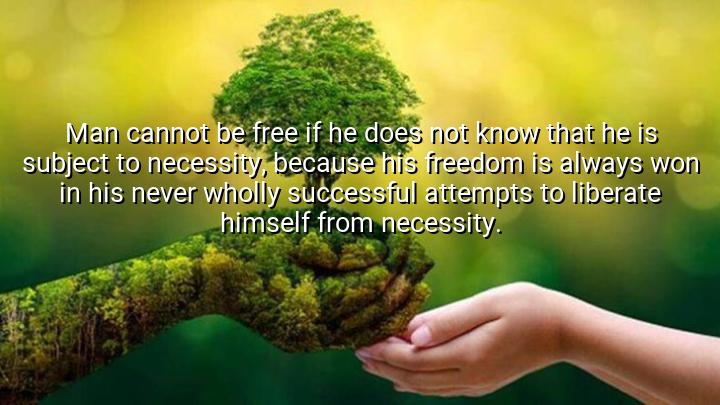




The quote "Man cannot be free if he does not know that he is subject to necessity, because his freedom is always won in his never wholly successful attempts to liberate himself from necessity" by Hannah Arendt explores the complex relationship between freedom and necessity. Arendt suggests that true freedom cannot exist without an awareness of the constraints or forces that limit us—what she refers to as necessity. Understanding these limitations is essential because freedom is not the absence of all constraints, but rather the ability to navigate and challenge them, even if complete liberation is never fully achieved.
Arendt's perspective on freedom is rooted in the idea that human beings are always bound by certain necessities—whether social, political, or natural—that shape their lives. However, she argues that freedom emerges through our constant efforts to overcome these necessities, even though we may never fully escape them. In this sense, freedom is a dynamic process, not a static state. The very act of struggling against constraints is what gives us a sense of agency and autonomy, even if we are never completely free from external forces.
The origin of this quote lies in Arendt's broader philosophical exploration of human action and political theory. She was deeply interested in how individuals can maintain a sense of freedom in the face of societal and historical forces that impose limitations. For Arendt, freedom is not just about individual autonomy but is deeply intertwined with collective action and the ability to shape the world, even within the confines of necessity.
Ultimately, Arendt’s quote challenges the conventional notion of freedom as an absence of constraints. Instead, it emphasizes that freedom is found in our continual engagement with the necessities of life, and our efforts to transcend them, even though these efforts may never be entirely successful. It is through this ongoing struggle that we realize our freedom, not as the total removal of all limitations, but in our persistent attempts to overcome them.

AAdministratorAdministrator
Welcome, honored guests. Please leave a comment, we will respond soon