

Economic growth may one day turn out to be a curse rather than a good, and under no conditions can it either lead into freedom or constitute a proof for its existence.
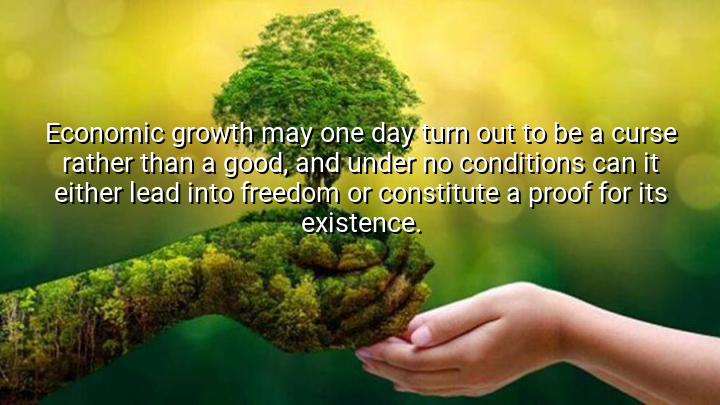




The quote "Economic growth may one day turn out to be a curse rather than a good, and under no conditions can it either lead into freedom or constitute a proof for its existence" by Hannah Arendt critiques the commonly held belief that economic growth automatically leads to freedom and progress. Arendt, a political theorist, argues that the focus on material progress and economic prosperity might ultimately be detrimental, as it can distract from or undermine more important values such as freedom and human dignity. She is warning against the assumption that the expansion of wealth and resources inherently fosters a freer and more just society.
The origin of this quote is found in Arendt's philosophical work on political theory and totalitarianism. Arendt was deeply concerned with the nature of modern society and the potential dangers of prioritizing economic growth over political and social freedom. In her analysis, she points out that material prosperity doesn't necessarily translate into political or personal freedom. Economic growth may even reinforce oppressive systems if it becomes the sole focus of a society, leading to alienation or exploitation rather than true freedom.
Arendt’s statement challenges the idea that economic success is a reliable indicator of societal well-being or liberty. Instead, she suggests that societies can become so consumed with material gain that they lose sight of the essential political freedoms that allow individuals to live self-determined lives. The pursuit of economic growth without a corresponding commitment to democratic principles or social justice can, in her view, create a society where people are more enslaved by their economic circumstances than liberated by the wealth generated.
Ultimately, Arendt’s quote warns against equating economic growth with freedom. She argues that a focus on material wealth can obscure the true nature of freedom, which she sees as rooted in the political realm and the active participation of individuals in democratic life. In this view, true freedom is not measured by economic success, but by the ability of individuals to act in the public realm, influence decisions, and live according to their values, rather than being controlled by economic forces.

AAdministratorAdministrator
Welcome, honored guests. Please leave a comment, we will respond soon