

Love has no age, no limit; and no death.
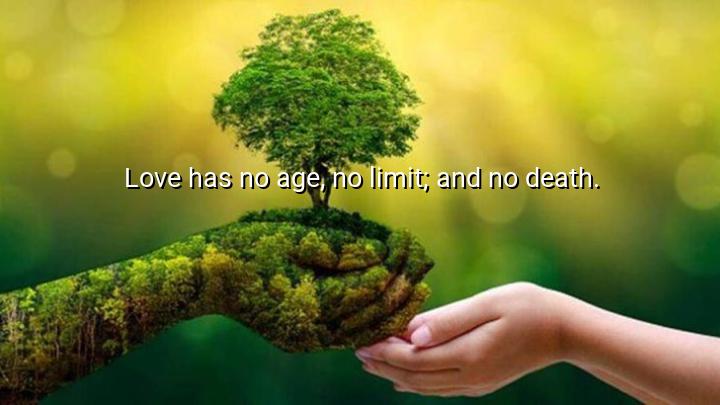




The quote "Love has no age, no limit; and no death" by John Galsworthy reflects the timeless and boundless nature of love. Galsworthy, a British novelist and playwright best known for his work The Forsyte Saga, suggests that love transcends the physical limitations of age and the constraints of time. According to this perspective, love is not bound by the aging process, the physical body, or even death, meaning that true love is eternal and enduring, unaffected by the inevitable changes that come with life.
Galsworthy’s quote emphasizes that love is an immaterial force that cannot be confined by traditional measures. While humans experience age, change, and loss, love is portrayed as something that exists beyond these temporal limitations. This idea positions love as a constant, unchanging force that continues to exist, even when physical appearances or life circumstances evolve.
The phrase "no death" is especially significant, as it suggests that love, unlike physical life, is impervious to mortality. It implies that love doesn’t end with the passing of someone or with the physical end of life. Instead, love can persist in memory, legacy, and spirit, offering a sense of continuity that transcends the finite nature of human existence. This belief in love’s immortality provides comfort and a sense of permanence.
Ultimately, Galsworthy’s quote invites us to celebrate love as something eternal, undisturbed by the physical processes of aging or death. It emphasizes that love, in its truest form, is not only a powerful emotion but also a transcendent force that connects individuals beyond the confines of time, age, and mortality. This understanding of love encourages us to cherish and honor the relationships that bring us joy, knowing that love itself remains unshaken by life's inevitable changes.

MLMai Lan
I appreciate the emotional depth in this quote. It suggests love is something more spiritual than physical—something that transcends age and mortality. But how does that translate into our everyday lives? Can two people who fall in love at different life stages really experience love the same way? Does the lack of limits mean love is truly universal, or just that it's deeply personal and can't be defined by others?
NTThuy Quynh Nguyen Thi
This quote reminds me of stories where people reconnect after decades apart and still feel the same deep affection. It’s beautiful to imagine love existing outside of time. But I also wonder—can this idea of eternal love be harmful if it keeps people stuck in the past, waiting for something to return? At what point does holding on to love become limiting rather than liberating?
KHNguyen Thi Khanh Huyen
The quote made me smile, but also made me think. If love truly has no age, why do so many people still judge age-gap relationships? Society often claims to value love above all, yet we still set rules around who, when, and how we should love. Is it possible to fully embrace this ideal without challenging some of our deeply held social norms?
ATTa Nguyen Anh Thao
This is such a romantic notion, but I can't help but question it. Isn't love, in some ways, bound by time and life circumstances? People change, relationships shift, and sometimes love does end. So what kind of love is Galsworthy referring to here—romantic, familial, spiritual? Is he idealizing love in a way that isn’t quite realistic, or is there a deeper truth we often overlook?
TVNguyen Kieu Tieu Vy
I find this quote incredibly moving, especially the part about love having no death. It suggests that love continues even after someone is gone. That makes me think about grief and how we continue to love people we've lost. Do you think this perspective helps people heal, or could it make letting go harder? I’d love to hear how others interpret the idea of love as eternal.