

Look at your business and the activities that you undertake. Then, start to think about not just your economic concerns, but about social and environmental impacts that businesses have.
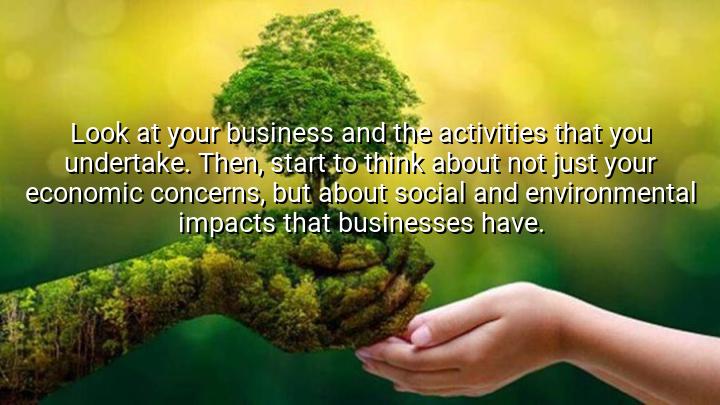




The quote "Look at your business and the activities that you undertake. Then, start to think about not just your economic concerns, but about social and environmental impacts that businesses have." by Jerry Greenfield encourages business leaders to broaden their perspective beyond financial gains. Greenfield highlights the importance of considering the broader consequences of business activities, particularly their impact on society and the environment. He calls for a more holistic approach to business management, where ethical and sustainable practices are prioritized alongside traditional profit goals.
The origin of this quote comes from Greenfield's work as the co-founder of Ben & Jerry's, a company known for its strong commitment to social responsibility and environmental sustainability. Greenfield and his business partner, Ben Cohen, were pioneers in integrating social issues into their company’s mission, seeking to create products that were not only delicious but also supported environmental and social causes. This quote reflects Greenfield’s belief that companies should not operate solely for economic profit but should actively consider their role in creating positive social and environmental outcomes.
By urging business leaders to think beyond economic concerns, Greenfield advocates for a more ethical approach to corporate decision-making. His call to consider the social and environmental impacts of business aligns with the growing movement for corporate social responsibility (CSR), where companies are expected to balance profit with social good. This perspective challenges the traditional view that business success is purely measured by financial performance.
In essence, Greenfield is emphasizing the need for businesses to take responsibility for their impact on the world around them. He suggests that true success in business should not be defined by financial metrics alone, but by how well a company contributes to the well-being of society and the sustainability of the planet. This approach calls for a fundamental shift in how businesses measure their success, encouraging them to adopt more responsible and thoughtful practices.

AAdministratorAdministrator
Welcome, honored guests. Please leave a comment, we will respond soon