

Isn't it enough to see that a garden is beautiful without having to believe that there are fairies at the bottom of it too?
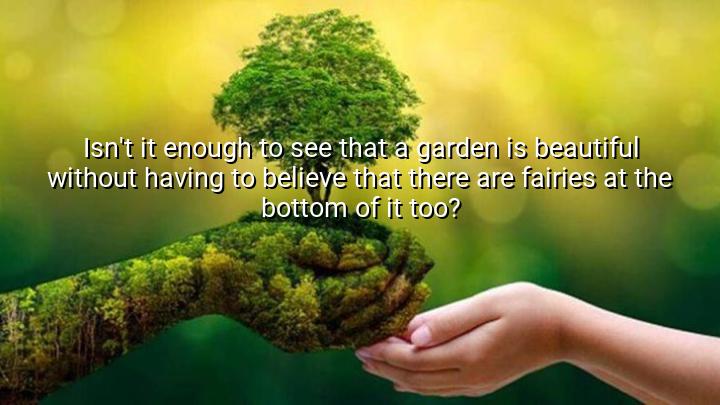




The quote by Douglas Adams, "Isn't it enough to see that a garden is beautiful without having to believe that there are fairies at the bottom of it too?" plays with the tension between imagination and reality. Adams is suggesting that it should be enough to appreciate the beauty of nature for what it is, without feeling the need to add extra, fanciful elements like fairies to enhance the experience. This reflects a desire to enjoy the world as it is, valuing its inherent qualities rather than relying on supernatural or mythical explanations to make it more magical.
Adams’ question also touches on the theme of skepticism and the idea that humans often feel the need to embellish or overcomplicate simple, natural experiences. He humorously implies that while adding layers of fantasy or mysticism can make things more intriguing, it might also detract from the straightforward enjoyment of what is already present. The garden, in this case, is beautiful on its own, and there is no need to believe in fairies to appreciate its simplicity and aesthetic value.
The quote can also be seen as a reflection of Adams’ wit and his ability to blend humor with deeper philosophical ideas. Known for his work on science fiction, particularly The Hitchhiker's Guide to the Galaxy, Adams often explored themes of absurdity and the human tendency to seek meaning or explanations where none are necessary. In this context, his remark about fairies serves as a playful critique of the human desire to overcomplicate or over-romanticize simple truths.
The origin of the quote is tied to Douglas Adams’ unique perspective on life and the natural world, where he often combined humor with a questioning of conventional wisdom. As a writer, Adams celebrated both the absurdity of life and the beauty of the world as it is, encouraging people to enjoy what they have without needing to add layers of unnecessary fantasy. This quote captures his wit while also encouraging a grounded appreciation of the world’s natural beauty.

AAdministratorAdministrator
Welcome, honored guests. Please leave a comment, we will respond soon