

Life is wasted on the living.
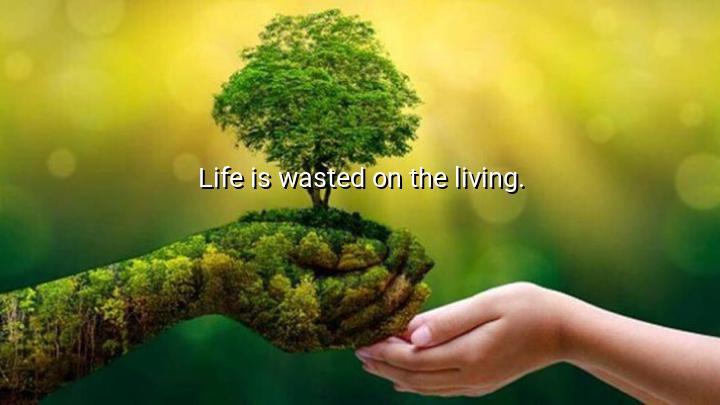




The quote "Life is wasted on the living" by Douglas Adams is a playful and ironic reflection on the human condition. It suggests that life—with all its complexity, beauty, and opportunities—is often squandered or misunderstood by the very people who experience it. In this context, Adams is pointing out how we, as the living, may fail to fully appreciate the preciousness or transience of life, and instead spend it on petty concerns, mundane routines, or unfulfilled desires. The quote is infused with a sense of irony, implying that the full richness of existence might be better appreciated by those who no longer experience it.
Adams, best known for his work The Hitchhiker’s Guide to the Galaxy, often used humor and absurdity to comment on serious themes like life, death, and the meaning of existence. The quote itself is characteristic of his wit—combining a philosophical observation with a tone of lightheartedness. In his writing, Adams frequently explored the ironic nature of human existence, suggesting that life’s grand truths are often obscured by our obsession with superficial concerns. This quote challenges the way we view our time on Earth, encouraging us to reflect on how we spend it.
The origin of this quote likely stems from Adams’ broader musings on life and death throughout his works, where he often employed satire to address existential questions. In The Hitchhiker’s Guide to the Galaxy, Adams explored the randomness of the universe, the fleeting nature of existence, and the absurdity of human life in the grand scheme of the cosmos. His quote here can be seen as a direct nod to his belief in the absurdity of the human struggle for meaning in a vast, indifferent universe. The line also plays on the idea that death, which many fear, might actually bring greater clarity and understanding than life ever does.
Ultimately, Adams’ quote serves as both a humorous and thought-provoking commentary on how we experience life. By stating that "life is wasted on the living," Adams invites us to question whether we truly appreciate our time and if we are making the most of it. In his characteristic style, the quote blends philosophical reflection with humor, urging us to take a step back and reconsider how we view the fleeting, precious moments we often take for granted.

AAdministratorAdministrator
Welcome, honored guests. Please leave a comment, we will respond soon