

To see a world in a grain of sand and heaven in a wild flower Hold infinity in the palm of your hand and eternity in an hour.
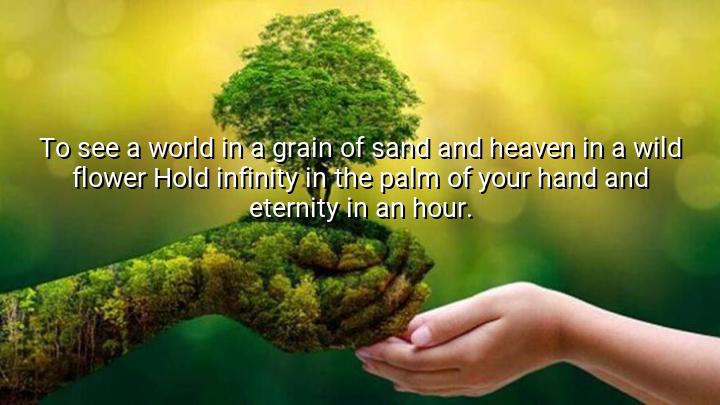




In this quote, William Blake expresses the idea that the vastness of the universe and the concept of eternity can be found in the smallest, most ordinary things. The line "To see a world in a grain of sand" suggests that even the tiniest objects or moments hold infinite potential and meaning. By contemplating something as small as a grain of sand or a wild flower, one can tap into the broader mysteries of existence, discovering beauty and depth in the simplest aspects of life.
Blake continues with the notion that one can "hold infinity in the palm of your hand and eternity in an hour." This emphasizes how the boundless concepts of time and space are not external, distant ideas but can be perceived in the present moment, in our everyday experiences. Blake suggests that by being fully present and attuned to the world around us, we can access deeper understandings of life, finding profound meaning in what might seem fleeting or insignificant.
The origin of this quote comes from Blake’s collection of poems, Auguries of Innocence, in which he often explored the interplay between the finite and infinite, nature, and the human soul. Blake’s poetic philosophy was rooted in his belief that the physical world reflects a deeper, spiritual reality, and he frequently used symbolic imagery to express his vision of the world’s interconnectedness.
Ultimately, Blake’s quote encourages a shift in perspective, urging us to recognize the infinite and the eternal in the everyday, often overlooked aspects of life. By appreciating the small, seemingly insignificant things—like a grain of sand or a wild flower—we can connect to the vastness of the universe and the timeless truths that underlie our existence.

AAdministratorAdministrator
Welcome, honored guests. Please leave a comment, we will respond soon