

Irrespective of age, we mourn for those loved and lost. Mourning is one of the deepest expressions of pure love.
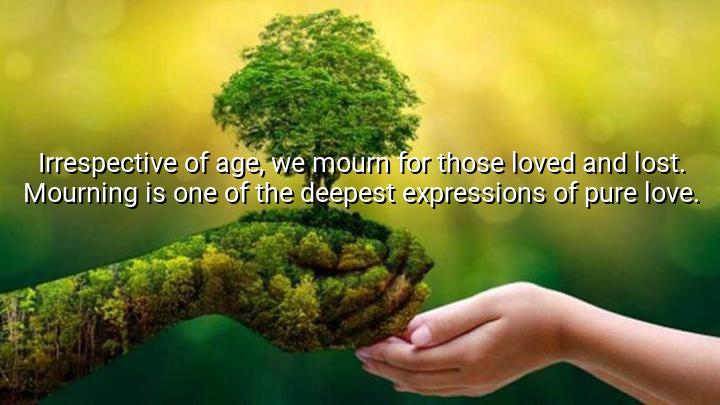




In this quote, Russell M. Nelson speaks to the universal experience of mourning, emphasizing that it transcends age. He suggests that regardless of how old someone is, the loss of a loved one brings about a profound sense of grief. Mourning is portrayed as a natural and inevitable response to losing someone close, highlighting its deep emotional significance. Nelson emphasizes that mourning is not simply a sorrowful experience but also a reflection of the love one had for the person who has passed.
Nelson’s statement also links mourning to love, suggesting that the intensity of grief is directly tied to the depth of affection we feel for others. He views mourning as one of the purest expressions of love because it reflects how much someone meant to us and the impact they had on our lives. The more deeply we love someone, the more profoundly we feel their loss, and mourning becomes a natural expression of that bond.
This quote also speaks to the idea that love is not bound by time or age. Whether someone is young or old, the experience of losing a loved one brings about the same fundamental emotions. Nelson’s words imply that the strength of human connection and the bonds we form throughout life are what give mourning its meaning and universality. It underscores the idea that mourning, though painful, is a testament to the richness of our emotional lives.
Ultimately, Russell M. Nelson reminds us that mourning is not only a response to loss but also a reflection of the love we feel for others. It serves as a powerful reminder that grief is a sacred and profound emotion, showing the deep, lasting connections we form throughout our lives.

NAHoang Nguyen Nhat An
This quote brings a sense of peace to the experience of mourning. It’s comforting to think that our grief shows how much love we had for someone. But does mourning always come with the same intensity? Some people seem to mourn deeply for pets or even lost opportunities. How can we explain the variety in mourning experiences if, as Russell M. Nelson suggests, it’s all rooted in love? Does the depth of love really determine the depth of mourning?
TTNGUYEN TRUNG THANH
I love the idea that mourning represents pure love, but does that mean all grief is justified? What if someone mourns for someone they didn't get along with, or even someone who caused them harm? Is that still a deep expression of love, or does it reflect something else, like a desire for closure? I’m curious about how mourning might shift in these more complicated emotional situations. What’s the line between mourning and unhealthy attachment?
NHNguyen Thi Ngoc Han
Russell M. Nelson’s perspective is beautiful, yet I wonder if mourning always feels like an act of love. Sometimes grief can also be associated with regret, guilt, or even anger. Is it possible that love can be the root of all mourning, or do we sometimes mourn for things that were less than perfect relationships? How do we reconcile these more complicated emotions with the idea that mourning is simply a reflection of love?
MK18 Nguyen Huynh My Kim
This quote really resonates with me. It's comforting to think that mourning is an expression of love. But I wonder, does everyone mourn in the same way? Some people seem to go through grief much more quietly, while others seem overwhelmed by it. Is the intensity of mourning proportional to the depth of love, or is it more complex than that? I think it would be interesting to hear more perspectives on how mourning manifests in different people.
LHLan Huong
I find this quote deeply moving, especially the idea that mourning is tied to love. It makes me think about how we often view grief as something negative, when in reality, it’s just a reflection of how much we cared. But, can mourning be a sign of unresolved emotions as well? Is there a point when mourning becomes unhealthy, or is it always just an expression of pure love, as Russell M. Nelson suggests?