

Inequality can have a bad downside, but equality, for its part, sure does get in the way of coordination.
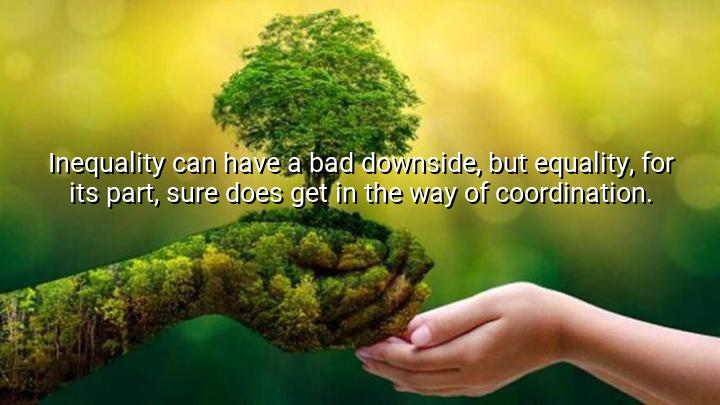




In this quote, Mary Douglas, an influential British anthropologist, explores the complexities of inequality and equality in social systems. She acknowledges that inequality has negative consequences, but she also points out that equality, while a desirable ideal, can sometimes hinder coordination. Douglas suggests that when everyone is treated equally, it can disrupt the social order or make it difficult to achieve effective group dynamics. The implication here is that systems that aim for absolute equality may struggle with practical challenges, especially when certain roles or hierarchies are necessary for the smooth functioning of a society.
Douglas’ perspective highlights a social paradox where equality, although morally and ethically sound, might not always be the best for achieving specific social coordination. For example, in certain group settings, leadership, authority, and specialization may be required for efficient decision-making and task completion. By promoting equality across all members, the natural diversity in skills, experiences, and leadership qualities might become blurred, potentially leading to disorganization or inefficiency. Thus, while equality is a worthy goal, Douglas suggests that in some cases, differences and hierarchies could serve a more functional purpose.
The origin of this quote lies within Mary Douglas’ broader academic work on culture, rituals, and social organization. Her work often dealt with the ways that societies organize themselves and the role of rituals and symbolic systems in maintaining social order. Her focus on how equality can sometimes impede coordination reflects her interest in the balance between individual rights and societal needs. Douglas believed that while equality is crucial in addressing injustices, it might also conflict with the practicalities of group cohesion and social stability.
In essence, this quote challenges the often straightforward assumption that equality is always the best solution to social issues. While equality promotes fairness and justice, Douglas' analysis reminds us that practical coordination within a society might sometimes require a different approach, one that allows for distinctions between roles, statuses, and contributions. It serves as a call to consider balance in societal structures—recognizing the value of equality while acknowledging the need for hierarchy and coordination in certain contexts.

AAdministratorAdministrator
Welcome, honored guests. Please leave a comment, we will respond soon