

Religion can make it worse. Are you supposing that if people were encouraged to believe in a transcendent reality, and to be encouraged by grand rituals and music and preaching, to love their neighbors, then they would put jealousy and frustration aside?
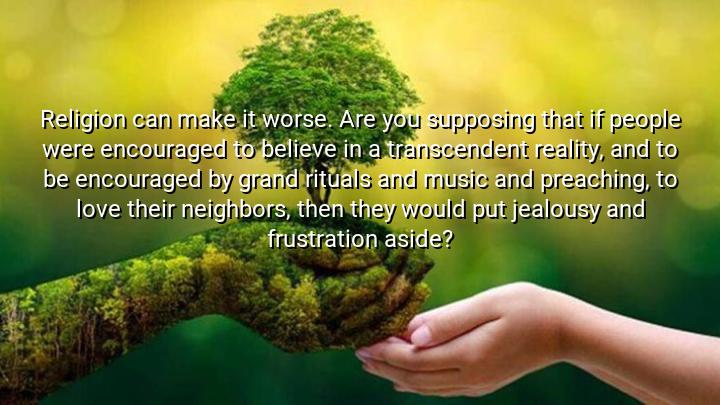




The quote by Mary Douglas, "Religion can make it worse. Are you supposing that if people were encouraged to believe in a transcendent reality, and to be encouraged by grand rituals and music and preaching, to love their neighbors, then they would put jealousy and frustration aside?" critically examines the role of religion in regulating human behavior. Douglas questions the assumption that religious belief and practice automatically eliminate negative emotions like jealousy and frustration, suggesting that even structured spiritual guidance cannot fully control human nature.
By highlighting rituals, music, and preaching, Douglas emphasizes the traditional tools of religion intended to foster moral and social cohesion. However, she points out the potential limits of these methods, indicating that despite their grandeur and intention, humans may still struggle with innate emotions and interpersonal conflicts. The quote challenges idealistic views of religion as a perfect moral corrective.
The origin of the quote comes from Mary Douglas, a British anthropologist renowned for her work on cultural symbolism, social structures, and religious practices. Douglas often explored how human behaviors, including emotions like jealousy, are mediated by social norms and belief systems, but she also recognized that cultural frameworks are not foolproof in shaping morality or eliminating conflict.
Ultimately, the quote underscores the complexity of human emotions and the limits of external systems, including religion, in controlling them. Douglas encourages a realistic perspective: while belief in a transcendent reality and participation in rituals may guide behavior, humans must contend with their own jealousy, frustration, and imperfection, highlighting the persistent challenges of human social life.

AAdministratorAdministrator
Welcome, honored guests. Please leave a comment, we will respond soon