

In youth we learn; in age we understand.
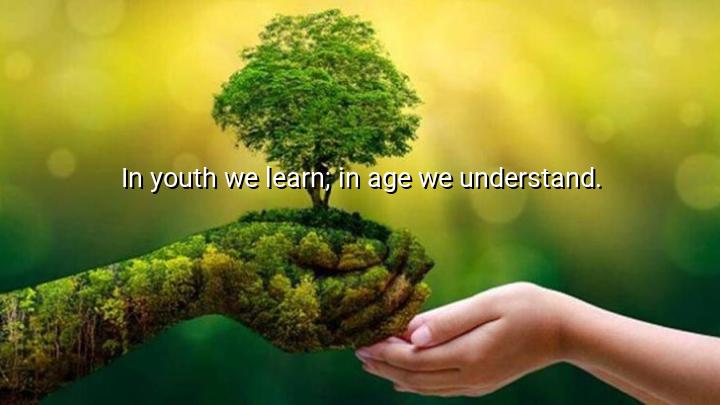




The quote "In youth we learn; in age we understand" by Marie von Ebner-Eschenbach reflects the distinction between knowledge and wisdom as we progress through life. Ebner-Eschenbach, an Austrian writer and philosopher, suggests that youth is a time for gaining knowledge and absorbing new information, while age is when we begin to process and integrate that knowledge into a deeper understanding of the world. In youth, we often gather facts and ideas, but it is through experience and the passage of time that we develop the insight and wisdom to make sense of those lessons.
The quote also speaks to the natural evolution of personal growth. In early life, we are often focused on learning, whether through formal education or personal experience, but the true value of this knowledge often becomes clear only later in life. As we age, we have more opportunities to reflect on our experiences, and our perspective shifts from just knowing things to truly understanding how those things apply to the complexities of life. This understanding comes with the maturity and reflection that often accompany older age.
Ebner-Eschenbach’s words also emphasize the difference between acquiring information and actually wisely applying it. While youth is about the process of learning and exploring new ideas, age brings the ability to see things in a broader context, drawing connections and understanding the deeper meaning behind what we have learned. This idea reinforces the notion that life experience is just as important as the facts we gather along the way.
Ultimately, the quote highlights the value of aging—not as a period of loss, but as a time for deeper reflection, understanding, and the integration of life’s lessons. It invites us to appreciate that the process of learning and understanding unfolds over time, and that with age, we gain a more complete and enlightened perspective on life’s complexities.

MHMinh Hoang
This really makes me think about the pace of personal development. It suggests that learning is immediate and active, while understanding is gradual and reflective. I wonder if we live in a culture that values the first more than the second—celebrating quick learners and youthful energy over the patient insights of older minds. How can we make space for the kind of deep understanding that comes only with time?
MQMinh Quang
It’s beautifully said, but it also leaves me with a question: what about those who never stop learning, even in old age? Or those who seem wise beyond their years? This quote draws a clear line between youth and age, but life isn’t always that linear. Do you think understanding can sometimes come early, or that some people stay learners forever without quite reaching deeper comprehension?
TPNguyen Tan Phat
I love how this quote distinguishes between acquiring information and internalizing meaning. It makes me question the way we approach education—should we be doing more to help young people not just learn, but begin to understand sooner? Is emotional intelligence teachable, or does it really only emerge through age and experience? And if so, how can society foster that kind of long-term personal growth?
PTNguyen Phuong Thao
This quote hits hard because it reminds me how different stages of life offer different kinds of insight. But I also wonder—what happens when someone doesn't get the chance to reach that point of understanding? Can hardship, trauma, or even premature death interrupt the natural flow from learning to understanding? It makes me appreciate how important reflection and longevity are to the depth of our awareness.
Llyly
Such a profound observation. It makes me wonder if we undervalue the role of older generations in our society. If understanding comes with age, shouldn’t we be listening more to those who have lived through decades of experiences? What would it look like if we prioritized intergenerational conversations more—if learning didn’t just stop with the young, but became a two-way street between youth and age?