

In the Orthodox religion, you don't draw the human figure. It's against the rules.
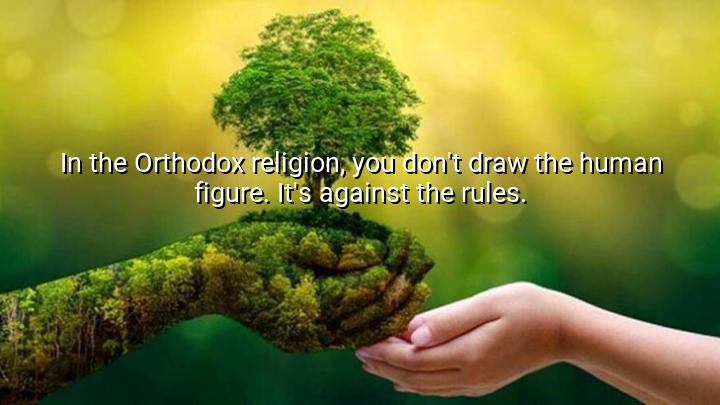




The quote "In the Orthodox religion, you don't draw the human figure. It's against the rules" by Paul Rand refers to a specific cultural and religious restriction in certain traditions of Orthodox Christianity. In many branches of Orthodox Christianity, particularly in the Eastern Orthodox Church, there are strict guidelines on religious art and iconography. The depiction of the human figure in religious icons is often avoided or handled with great reverence and stylization, as it is believed that creating images of the human form can be a distraction or even a form of idolatry. This quote reflects how religious rules can shape artistic expression and influence the way spiritual figures are represented.
Paul Rand, a legendary graphic designer known for his work in corporate identity and branding, often discussed the tension between artistic freedom and cultural norms. His quote is likely a reflection on how certain religious and cultural practices impose constraints on creative expression. Rand, though primarily a designer, was deeply engaged with the philosophical aspects of art and design, and he understood how various societal forces—including religion—could impact what could be created, how it could be perceived, and the symbolism behind it.
The origin of this quote can be linked to the intersection of art and religion throughout history. In the Orthodox tradition, especially in regions like Greece and Russia, religious art took on very specific forms, often focusing on spiritual symbolism rather than realistic depictions of human beings. By referencing this restriction, Rand is likely drawing attention to the ways in which religious dogma can inform the creative process, offering a contrast between the more liberated approach to art in Western traditions and the more prescribed methods found in Orthodox communities.
Ultimately, this quote sheds light on the relationship between religion and artistic expression, where strict religious rules about representation shape the kinds of images that are allowed or prohibited. In Rand's context, it also reflects the broader tension between creativity and tradition, illustrating how even in an artistic field like graphic design, cultural and religious norms can serve as powerful influences on the direction of visual representation.

AAdministratorAdministrator
Welcome, honored guests. Please leave a comment, we will respond soon