

Graphic design, which evokes the symmetria of Vituvius, the dynamic symmetry of Hambidge, the asymmetry of Mondrian; which is a good gestalt, generated by intuition or by computer, by invention or by a system of coordinates, is not good design if it does not communicate.
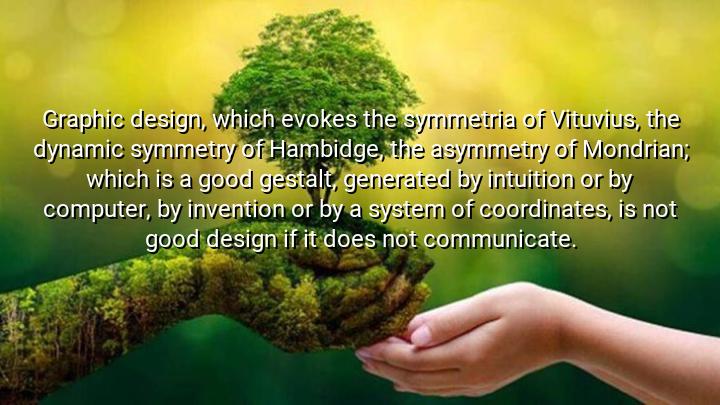




The quote by Paul Rand, "Graphic design, which evokes the symmetria of Vitruvius, the dynamic symmetry of Hambidge, the asymmetry of Mondrian; which is a good gestalt, generated by intuition or by computer, by invention or by a system of coordinates, is not good design if it does not communicate," emphasizes that graphic design must go beyond aesthetic principles and serve the purpose of effective communication. Rand, a pioneering figure in graphic design, draws on various historical and modern theories of design, such as Vitruvius' symmetria, Hambidge's dynamic symmetry, and Mondrian's asymmetry, to illustrate the different ways design principles can manifest. However, despite these theoretical approaches, he argues that the true measure of good design is whether it conveys a message or meaning clearly and effectively.
Rand references symmetry and asymmetry, concepts that have played a significant role in the history of design. Vitruvius’ symmetria focused on the balance and proportion of elements in architecture, while Hambidge's dynamic symmetry explored geometric relationships in composition, and Mondrian's approach to asymmetry played a vital role in creating harmonious but unconventional visual compositions. Each of these principles influences how elements in graphic design are structured, but Rand reminds us that regardless of the approach, the design must ultimately be functional and communicative.
He goes on to describe graphic design as a gestalt, a term that refers to the whole being greater than the sum of its parts. Whether a design is created by intuition, invention, or computer-generated systems, the end goal must always be to create something that resonates with the viewer. In Rand’s view, good design involves the careful balance of aesthetic choices and message delivery. Without effective communication, no amount of skillful design or theoretical approach will make it a successful piece of work.
Ultimately, Rand's quote underscores the importance of purpose in design. He suggests that the true value of graphic design lies in its ability to communicate an idea, convey information, or evoke a response. No matter how technically proficient or visually pleasing a design may be, it falls short if it does not fulfill the essential purpose of communication.

AAdministratorAdministrator
Welcome, honored guests. Please leave a comment, we will respond soon