

Design is a way of life, a point of view. It involves the whole complex of visual communications: talent, creative ability, manual skill, and technical knowledge. Aesthetics and economics, technology and psychology are intrinsically related to the process.
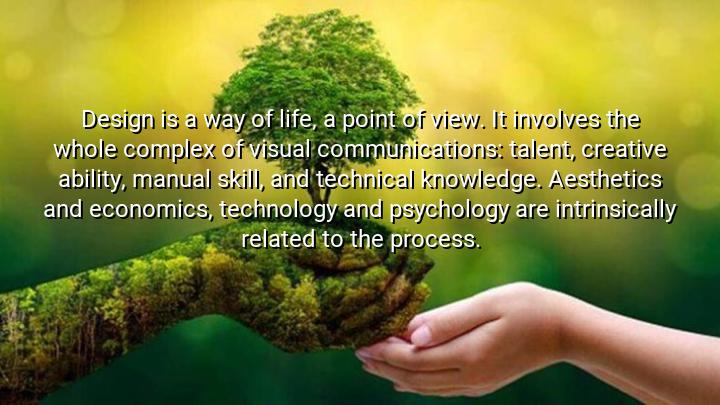




The quote “Design is a way of life, a point of view. It involves the whole complex of visual communications: talent, creative ability, manual skill, and technical knowledge. Aesthetics and economics, technology and psychology are intrinsically related to the process.” comes from Paul Rand, the American graphic designer best known for creating iconic corporate logos such as IBM, ABC, and UPS. In this statement, Rand presents his philosophy of design as more than just a professional practice—it is an all-encompassing worldview that integrates creativity, skill, and knowledge into a holistic process.
The meaning of the quote lies in Rand’s insistence that design is not merely about making things look attractive but about solving problems and communicating effectively. He describes it as a way of life, meaning that design requires a constant awareness of visual communication and its impact on society. By including aesthetics, economics, technology, and psychology in the process, Rand highlights that design is inherently interdisciplinary, shaped by both artistic vision and practical considerations.
The origin of this idea can be traced to Rand’s role in shaping modern graphic design during the mid-20th century. Influenced by the Bauhaus movement and modernist principles, Rand believed that design should combine functionality with beauty, serving both the needs of business and the experiences of people. His reflections, as expressed in books like Thoughts on Design (1947), sought to elevate graphic design to the status of a serious intellectual and cultural discipline, rather than a purely commercial craft.
Ultimately, Rand’s words underscore the depth and scope of design. They remind us that design involves much more than artistic flair—it is the integration of creativity, skill, and understanding of human behavior and societal needs. His philosophy helped redefine design as an essential component of modern life, influencing not only how companies present themselves but also how people interact with the visual world around them.

AAdministratorAdministrator
Welcome, honored guests. Please leave a comment, we will respond soon