

To design is much more than simply to assemble, to order, or even to edit: it is to add value and meaning, to illuminate, to simplify, to clarify, to modify, to dignify, to dramatize, to persuade, and perhaps even to amuse. To design is to transform prose into poetry.
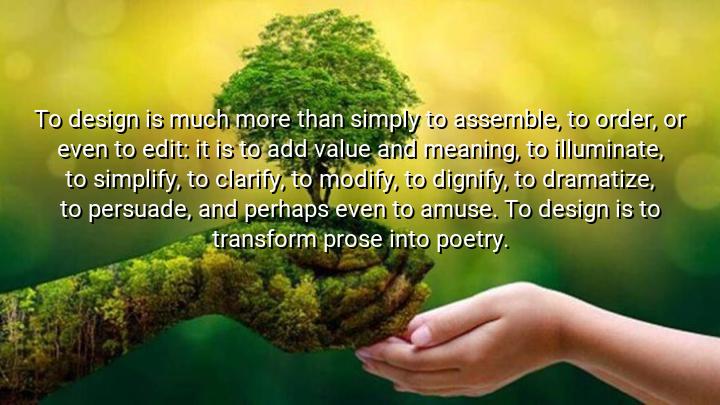




The quote by Paul Rand highlights his belief that design is not a mechanical task of merely assembling, ordering, or editing elements, but rather an act of creation and transformation. For Rand, design goes beyond arrangement; it is about adding value and meaning to communication. Through design, ordinary content can be made clearer, more engaging, and more impactful.
He describes design as a process that can illuminate, simplify, clarify, modify, dignify, dramatize, persuade, and even amuse. Each of these verbs captures the multifaceted power of design to shape perception and evoke emotion. Design is not just about aesthetics—it influences how people understand, connect with, and respond to ideas. In this way, design becomes a bridge between function and feeling, between message and audience.
Rand’s final line, “To design is to transform prose into poetry,” beautifully encapsulates his philosophy. Just as poetry elevates language by imbuing it with rhythm, imagery, and resonance, design elevates content by turning the ordinary into something meaningful and memorable. This metaphor underscores his conviction that design is both art and communication, capable of transforming simple information into an experience.
The origin of this quote lies in Rand’s legacy as one of the most influential graphic designers of the 20th century. Known for creating iconic corporate logos such as IBM, UPS, and ABC, he championed design as a discipline that combined clarity, creativity, and function. His writings and work consistently emphasized that design is not decoration but a form of storytelling that can elevate communication to an art form—much like turning prose into poetry.

AAdministratorAdministrator
Welcome, honored guests. Please leave a comment, we will respond soon