

I have a dream that one day on the red hills of Georgia, the sons of former slaves and the sons of former slave owners will be able to sit together at the table of brotherhood.
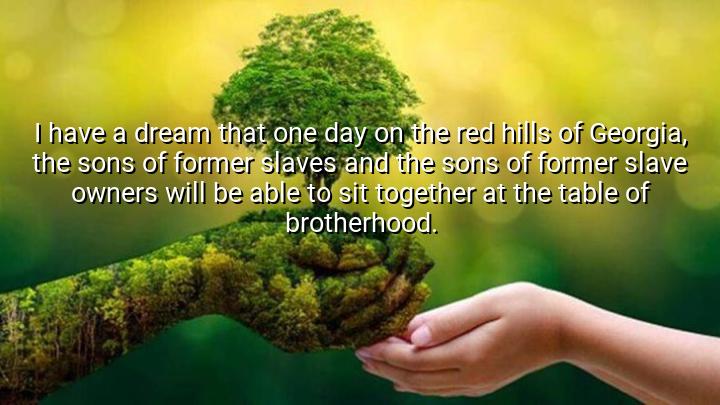




Martin Luther King, Jr.'s quote, "I have a dream that one day on the red hills of Georgia, the sons of former slaves and the sons of former slave owners will be able to sit together at the table of brotherhood," encapsulates his vision of racial reconciliation and unity. In this powerful statement, King imagines a future where the deep divisions caused by slavery and racial oppression in the United States are healed. The "red hills of Georgia" symbolize the South, where the history of slavery is deeply rooted, and King dreams of a time when those who have been historically divided by race and history can come together in harmony.
The phrase "sons of former slaves and the sons of former slave owners" highlights the legacy of slavery and its continuing impact on race relations in America. King’s vision is one of healing and reconciliation, where people from opposite sides of a painful historical conflict can move beyond resentment and work toward common goals. The "table of brotherhood" represents a place of mutual respect, equality, and shared humanity, emphasizing King's belief in peace and love as the foundation for social change.
The quote originates from King's famous "I Have a Dream" speech, delivered during the March on Washington for Jobs and Freedom on August 28, 1963. The speech, which is one of the most iconic in American history, outlined King’s vision for a future where racial equality and justice were realized, and his call for an end to discrimination resonated deeply with people both in the United States and around the world. This particular line highlights King's belief in the transformative power of forgiveness and the possibility of building a just society that recognizes the dignity of all people, regardless of race or background.
Ultimately, King's quote is a call for reconciliation and a hopeful vision of a future where the scars of the past can be healed. It reflects his unwavering belief that, despite the deep-seated hatred and division caused by slavery and racism, there is a way forward—a way to build a unified and equitable society based on brotherhood, love, and mutual respect.

AAdministratorAdministrator
Welcome, honored guests. Please leave a comment, we will respond soon