

I grew up in a family of peasants, and it was there that I saw the way that, for example, our wheat fields suffered as a result of dust storms, water erosion and wind erosion; I saw the effect of that on life - on human life.
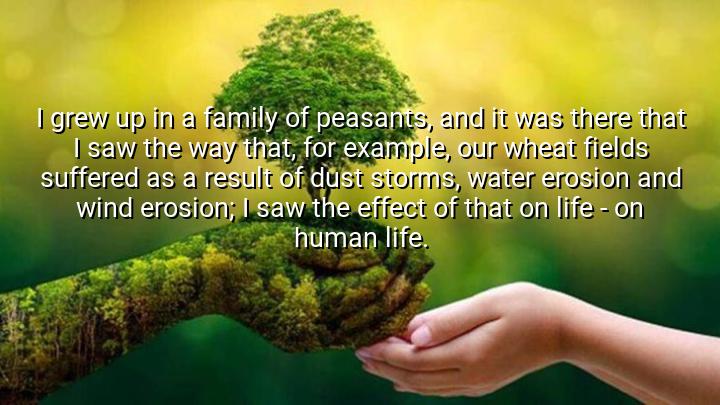




The quote “I grew up in a family of peasants, and it was there that I saw the way that, for example, our wheat fields suffered as a result of dust storms, water erosion and wind erosion; I saw the effect of that on life - on human life” by Mikhail Gorbachev reflects his humble beginnings and the impact of environmental challenges on daily life. By describing his family of peasants and the wheat fields damaged by dust storms, water erosion, and wind erosion, Gorbachev connects the struggles of agriculture to the struggles of human survival. The keywords—peasants, wheat fields, erosion, and human life—emphasize his awareness of the close relationship between nature and human well-being.
The origin of this quote comes from Mikhail Gorbachev, the last leader of the Soviet Union and a reformist political figure known for policies like glasnost and perestroika. Gorbachev grew up in rural Russia in the Stavropol region, where his family worked the land and experienced hardships typical of peasant life. His firsthand experiences with agricultural labor and environmental hardship shaped his understanding of rural life and later influenced his interest in environmental and agricultural policy as a world leader.
The quote also highlights the human cost of environmental degradation. By linking damaged wheat fields to the effect on human life, Gorbachev shows a direct connection between nature’s health and human survival. For farming families, environmental issues were not abstract concepts but daily struggles that determined food supply, income, and overall well-being. His observation reflects an early environmental awareness born from personal experience, rather than just policy or theory.
Ultimately, Gorbachev’s reflection is about empathy, awareness, and the deep ties between people and the land. It underscores that family background and lived experience can shape a leader’s worldview, particularly in understanding the impact of environmental and economic challenges on ordinary human life. His words serve as both a personal memory and a reminder of how nature and humanity are inseparably connected.

AAdministratorAdministrator
Welcome, honored guests. Please leave a comment, we will respond soon