

I don't think I could have - and I wouldn't have wanted to - write a book about climate change that wasn't about justice and equality.
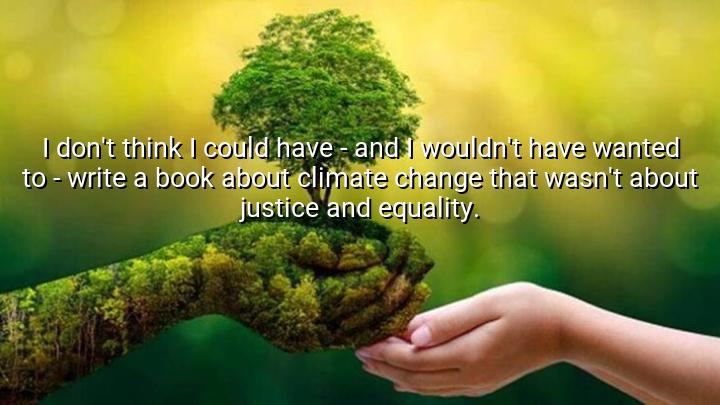




The quote by Tatiana Schlossberg, “I don't think I could have – and I wouldn't have wanted to – write a book about climate change that wasn't about justice and equality,” reflects her belief that environmental issues cannot be separated from social ones. She emphasizes that the impacts of climate change are not evenly distributed—marginalized and vulnerable communities often suffer the most, despite contributing the least to the problem. Thus, for Schlossberg, discussing environmental issues without acknowledging justice and equality would ignore the human dimension of the crisis.
The origin of this statement is connected to Schlossberg’s book, Inconspicuous Consumption: The Environmental Impact You Don’t Know You Have (2019). In this work, she explores the hidden ways daily habits and consumer choices affect the environment, and she frames the fight against climate change as inseparable from addressing systemic inequalities. Her approach highlights how global warming intersects with issues like race, poverty, and access to resources, making justice central to environmental advocacy.
Her perspective draws on a broader intellectual and activist tradition known as climate justice, which insists that environmental solutions must also address fairness and human rights. By linking climate change to equality, Schlossberg underscores that solving the crisis is not only a scientific or technological challenge, but also a moral one.
Ultimately, Schlossberg’s quote shows that tackling climate change requires more than reducing emissions; it demands building a society that values justice and equality. Her words remind us that the climate crisis is both an ecological and a social problem, and lasting solutions must account for both dimensions.

AAdministratorAdministrator
Welcome, honored guests. Please leave a comment, we will respond soon