

Human rights, of course, must include the right to religious freedom, understood as the expression of a dimension that is at once individual and communitarian - a vision that brings out the unity of the person while clearly distinguishing between the dimension of the citizen and that of the believer.
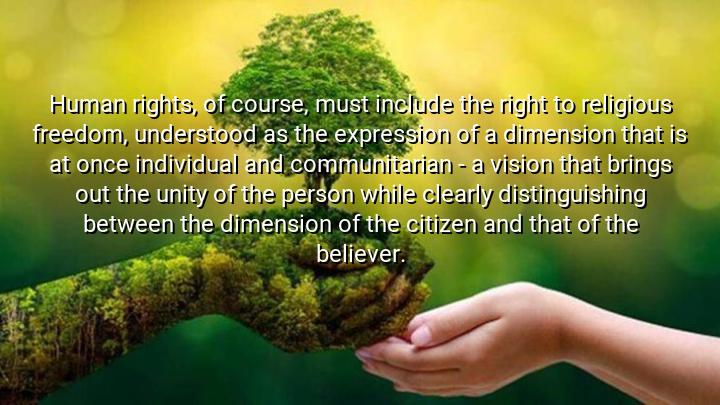




In this quote, Pope Benedict XVI emphasizes the essential role of religious freedom within the broader framework of human rights. He suggests that religious freedom is not just an individual right but also a communitarian one, meaning it involves both personal expression and the ability to practice faith within a community. By framing religious freedom in this dual light, he underscores its significance in fostering both individual autonomy and collective identity.
The Pope also makes an important distinction between the dimension of the citizen and that of the believer. He acknowledges that while individuals are citizens with certain rights and duties within the state, they also have a personal, spiritual dimension as believers. This distinction is important because it highlights that religious freedom goes beyond the rights conferred by the state, touching on deeper spiritual and personal dimensions of life that are integral to a person's identity.
This vision promotes a balanced understanding of human rights, where religious freedom is seen as an essential part of the human experience, allowing for the free expression of faith without conflicting with one’s civic duties. By supporting this idea, Pope Benedict XVI advocates for a society where both the individual and the community can practice their faith openly, while still recognizing the different roles one plays in public and spiritual spheres.
The origin of this thought can be traced back to Pope Benedict XVI's teachings on human dignity, where he frequently connected the concepts of freedom, faith, and human rights. His approach to religious freedom was rooted in the Catholic Church's long-standing commitment to upholding the dignity of the person and the importance of protecting the freedom to worship and practice religion in both personal and communal contexts.

AAdministratorAdministrator
Welcome, honored guests. Please leave a comment, we will respond soon