

The life of the community, both domestically and internationally, clearly demonstrates that respect for rights, and the guarantees that follow from them, are measures of the common good that serve to evaluate the relationship between justice and injustice, development and poverty, security and conflict.
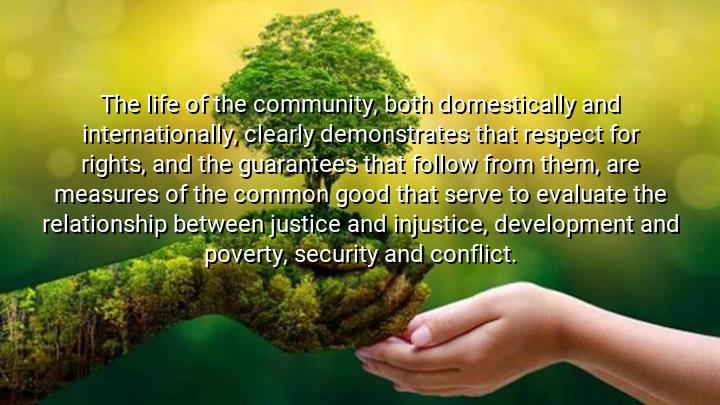




The quote, “The life of the community, both domestically and internationally, clearly demonstrates that respect for rights, and the guarantees that follow from them, are measures of the common good that serve to evaluate the relationship between justice and injustice, development and poverty, security and conflict.”, by Pope Benedict XVI, highlights the deep connection between human rights and the common good. He asserts that societies—whether at the local or global level—can be judged by how they respect and uphold the rights of individuals. These rights act as a measuring stick, revealing whether a society leans toward justice or injustice, development or poverty, security or conflict.
The origin of this statement lies in Pope Benedict XVI’s broader teachings on Catholic social doctrine, where human dignity and the protection of fundamental rights are considered central to peace and prosperity. His papacy often emphasized the moral responsibility of governments and international institutions to safeguard rights as a way of ensuring justice and fostering true human development. This perspective was shaped by Catholic tradition, which ties together faith, morality, and social responsibility.
The meaning also reflects the Pope’s concern with the balance between individual freedom and community responsibility. He suggests that the health of any community—whether a nation or the international system—depends on how it treats its most vulnerable members. Ignoring rights leads to poverty and conflict, while honoring them builds security and development. His framing links moral values with practical outcomes, making the case that respect for rights is not only a spiritual duty but also a pragmatic necessity for societal stability.
Ultimately, the quote serves as both a moral reminder and a political challenge. It calls on leaders and citizens alike to see the protection of human rights as the foundation for a just and peaceful world. Without this respect, the fractures of injustice, poverty, and conflict inevitably deepen. In essence, Pope Benedict XVI ties the idea of the common good directly to the ethical obligation of respecting every person’s inherent dignity.
Would you like me to also trace how this idea connects to the Universal Declaration of Human Rights and post–World War II thought, which heavily influenced Benedict’s era?

AAdministratorAdministrator
Welcome, honored guests. Please leave a comment, we will respond soon