

Help us to be ever faithful gardeners of the spirit, who know that without darkness nothing comes to birth, and without light nothing flowers.
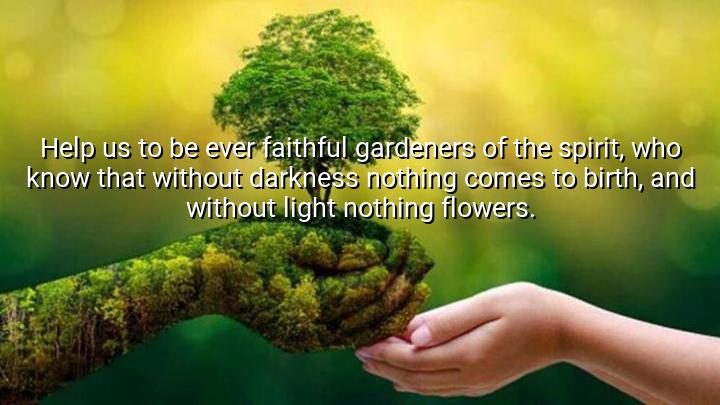




The quote by May Sarton, "Help us to be ever faithful gardeners of the spirit, who know that without darkness nothing comes to birth, and without light nothing flowers," speaks to the balance between light and darkness in the human experience. Sarton uses the metaphor of gardening to explore the emotional and spiritual journey of life, suggesting that both challenges (darkness) and joys (light) are essential for growth. Just as plants require both sunlight and shadow to thrive, our spirits also need a balance of difficult and uplifting experiences to develop fully.
Sarton’s reference to being "faithful gardeners of the spirit" implies that personal growth and self-awareness require consistent care and attention. Just as gardeners tend to their plants, we must tend to our own emotional and spiritual well-being, understanding that growth is not always linear or easy. The darkness represents life's struggles, losses, and hardships—experiences that may seem difficult at the time but are necessary for personal development and the birth of new strengths. The light, on the other hand, symbolizes the joy, hope, and success that emerge from overcoming those challenges.
The line, "without darkness nothing comes to birth, and without light nothing flowers," emphasizes that growth cannot occur in the absence of both opposites. Life's struggles and challenges are as necessary as moments of happiness and fulfillment. The quote reminds us that every experience—whether difficult or joyful—contributes to the wholeness of our lives and our ability to flourish. Both light and dark are crucial to the flowering of the spirit, just as they are to the flourishing of plants.
The origin of this quote is tied to May Sarton’s life and writing, where she frequently explored themes of inner growth, reflection, and the balance of opposing forces. Known for her poetry and prose, Sarton often delved into the complexities of the human spirit and the importance of embracing both the good and the bad aspects of life. This quote captures her belief in the transformative power of duality—that without experiencing both joy and pain, we would be unable to reach our full potential.

AAdministratorAdministrator
Welcome, honored guests. Please leave a comment, we will respond soon