

Corporate social responsibility is measured in terms of businesses improving conditions for their employees, shareholders, communities, and environment. But moral responsibility goes further, reflecting the need for corporations to address fundamental ethical issues such as inclusion, dignity, and equality.
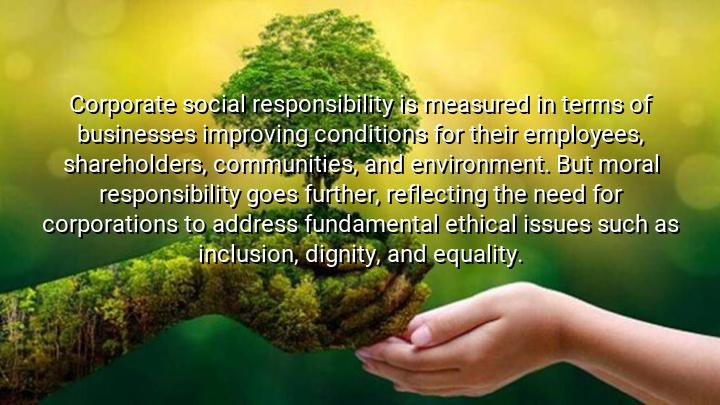




In this quote, Klaus Schwab, the founder and executive chairman of the World Economic Forum, draws a distinction between corporate social responsibility (CSR) and moral responsibility. CSR generally refers to the ways in which businesses improve conditions for their employees, shareholders, communities, and the environment, typically through actions that have a positive impact on society. Schwab suggests that while CSR focuses on tangible benefits like fair wages, environmental sustainability, and community support, moral responsibility extends further to address deeper ethical concerns within the corporate world.
Schwab argues that moral responsibility goes beyond simply improving external conditions and requires businesses to focus on fundamental ethical issues such as inclusion, dignity, and equality. For Schwab, this means that companies must also consider the human aspects of their operations, ensuring that all stakeholders are treated with respect and fairness. This includes addressing issues like workplace discrimination, providing equal opportunities for all employees, and fostering an inclusive environment where individuals are valued for their contributions, regardless of their background.
The mention of inclusion, dignity, and equality reflects a shift in the way corporations are expected to operate in the modern world. Schwab's perspective suggests that corporations should not only focus on profits but also on their role in creating a more just and equitable society. Companies that adopt this broader view of moral responsibility are seen as leaders who contribute positively to both the economy and the social fabric, ensuring that their business practices align with broader ethical principles.
Ultimately, Schwab’s quote highlights the growing importance of ethical considerations in the business world. He suggests that companies must go beyond mere legal compliance and financial success to take responsibility for their social and moral impact. By addressing fundamental issues like equality, businesses can not only improve their internal culture but also contribute to the well-being of society at large.

AAdministratorAdministrator
Welcome, honored guests. Please leave a comment, we will respond soon