

Computers are still technology because we are still wrestling with it: it's still being invented; we're still trying to work out how it works. There's a world of game interaction to come that you or I wouldn't recognise. It's time for the machines to disappear. The computer's got to disappear into all of the things we use.
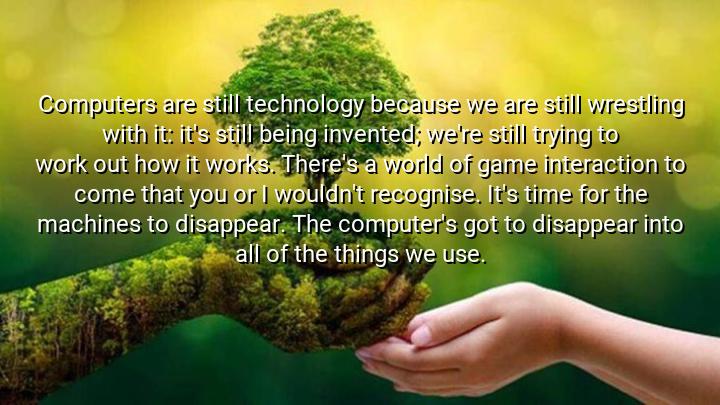




Douglas Adams’ quote, "Computers are still technology because we are still wrestling with it: it's still being invented; we're still trying to work out how it works. There's a world of game interaction to come that you or I wouldn't recognise. It's time for the machines to disappear. The computer's got to disappear into all of the things we use," highlights his view on the evolving role of computers and technology. Adams, known for his work in science fiction and as the author of The Hitchhiker’s Guide to the Galaxy, often explored the intersections of technology, humanity, and the unknown. In this quote, he reflects on the notion that computers, while central to modern life, are still in a phase of development, with much more to come in terms of interaction and integration.
Adams emphasizes that computers remain in the realm of technology because we are still figuring out how they work, and there is much to be discovered. This mirrors the uncertainty and rapid pace of technological innovation. The idea that “we’re still wrestling with it” implies that, despite the profound advances in computing, there is still a lot of exploration and trial-and-error involved in developing new systems, especially in areas like game interaction and user experience.
The mention of a "world of game interaction" that "you or I wouldn't recognise" suggests that future technological advancements will be so advanced and seamlessly integrated into our lives that they will be almost unrecognizable compared to today’s experiences. For Adams, this implies that technology will eventually evolve into something so intuitive and embedded in daily life that we won’t see computers as distinct devices anymore—they will simply be a part of the objects and tools we use every day.
In the final part of the quote, Adams advocates for the disappearance of the computer as a separate, tangible entity. He envisions a future where technology is so integrated into the fabric of our environment that the need to interact with a computer, as we understand it now, will be obsolete. The computer will become invisible, embedded in the things we use, creating a more seamless, intuitive experience for users. Ultimately, Adams is predicting a future where the complexity of technology becomes so natural that it blends into our daily lives without being a distinct or separate object.

AAdministratorAdministrator
Welcome, honored guests. Please leave a comment, we will respond soon