

But what is liberty without wisdom, and without virtue? It is the greatest of all possible evils; for it is folly, vice, and madness, without tuition or restraint.
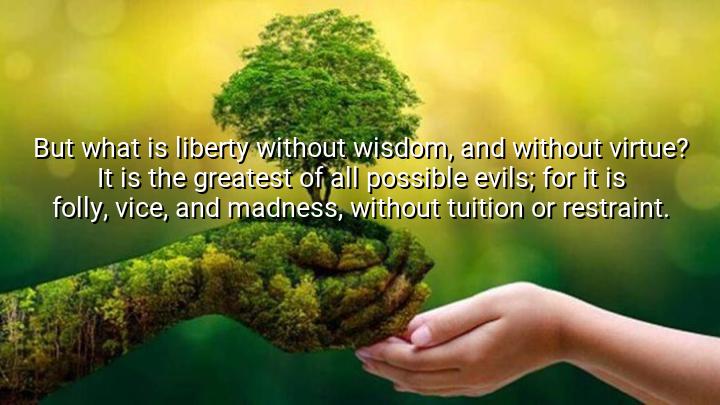




The quote by Edmund Burke warns that liberty without wisdom and virtue is not truly freedom but rather a dangerous and destructive force. Burke argues that while liberty is a highly valued ideal, it must be coupled with the guidance of wisdom and the moral foundation of virtue to be meaningful and sustainable. Without these, liberty becomes chaotic and harmful, as it leads to folly, vice, and madness. In essence, Burke is suggesting that unrestrained freedom, devoid of moral and intellectual guidance, can devolve into disorder and corruption.
Burke’s critique highlights the importance of restraint in the exercise of freedom. He believed that society's laws, traditions, and values should provide a framework within which liberty is exercised. Otherwise, without the tempering forces of wisdom and virtue, liberty could encourage irresponsible actions that undermine the well-being of individuals and society as a whole. This reflects his broader conservative philosophy, where he emphasized the role of tradition and moderation in maintaining social stability.
The origin of this quote is rooted in Burke's writings on politics and society, particularly in his response to the French Revolution. Burke was critical of the revolution’s emphasis on unrestrained liberty, fearing that it could lead to the destruction of social order. He argued that true liberty is not simply the absence of authority but the wise and virtuous use of freedom within a structured society. This quote is a reflection of his concern for the potential dangers of radical political change without the grounding influence of moral and intellectual discipline.
Ultimately, Burke’s quote is a call for a balance between freedom and responsibility. It suggests that liberty must be exercised thoughtfully and in alignment with ethical principles to prevent its descent into chaos. Burke’s warning underscores that true freedom is not about limitless autonomy, but about ensuring that liberty is tempered by wisdom, virtue, and a respect for the common good.

AAdministratorAdministrator
Welcome, honored guests. Please leave a comment, we will respond soon