

But the age of chivalry is gone. That of sophisters, economists, and calculators has succeeded; and the glory of Europe is extinguished forever.
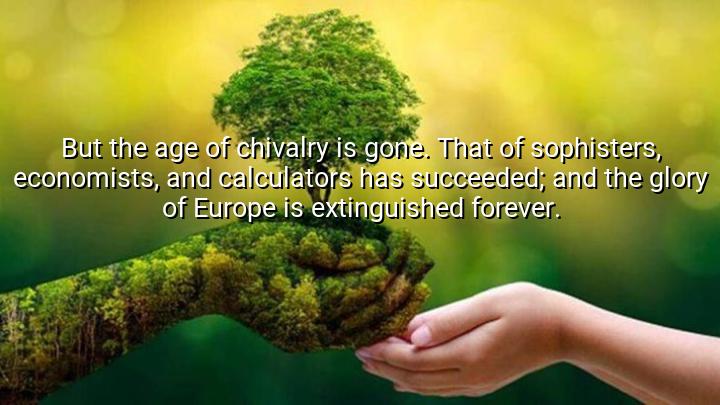




The quote, "But the age of chivalry is gone. That of sophisters, economists, and calculators has succeeded; and the glory of Europe is extinguished forever," comes from Edmund Burke, an Irish statesman, orator, and philosopher, best known for his writings on politics and society. This statement is part of his critique of the French Revolution and the societal changes of the 18th century. Burke mourns the end of an era where ideals such as honor, virtue, and chivalry governed both personal and political life, replacing them with what he saw as a more calculating and pragmatic age driven by reason and materialism.
Burke’s reference to the "age of chivalry" evokes an idealized past when knights, nobility, and traditional values held sway, and society was governed by honor and principles rather than mere pragmatism or self-interest. The "sophisters, economists, and calculators" represent the new intellectual and political class, which Burke believed was more focused on logic, utility, and economic calculation, rather than on moral or spiritual values. For Burke, this shift marked the decline of Europe’s glory, as it replaced noble ideals with a more cynical and utilitarian view of the world.
Burke’s critique is also aimed at the French Revolution, which he viewed as an attempt to radically reshape society based on reason and abstract principles, stripping away the traditional hierarchies and values that had defined European culture. The rise of sophisters (those who manipulate reasoning), economists, and calculators represented the triumph of rationality over virtue and tradition, leading to a society that Burke believed was devoid of the nobility and grandeur that once made Europe great.
Ultimately, Burke’s quote expresses his belief that Europe’s glory—shaped by centuries of tradition, nobility, and moral honor—had been extinguished by the rise of a new, more rational, and materialistic world. He viewed this transformation as a loss of the spiritual and cultural essence of Europe, replaced by a focus on economic and political calculation.

KANguyen Thi Kim Anh
Reading this, I feel a tension between emotion and logic, past and progress. Burke paints a Europe that has traded valor for calculation, but was that necessarily a bad trade? I wonder whether we idealize eras like chivalry because they appeal to our longing for meaning, even if they came with serious moral blind spots. What values do we lose when efficiency becomes our guiding principle? And are we aware of it as it happens?
Jjggg
There's a haunting beauty in Burke’s observation. It makes me think about how cultural shifts often feel like losses rather than evolutions. Is our modern world truly less noble, or just less mythologized? The 'age of chivalry' may be gone, but have we gained a better grasp of justice, equality, and reason? Or has something soulful been sacrificed for the sake of systems and metrics? It’s a question worth exploring deeply.
CDVu Chi Duc
I see this as a classic example of generational disillusionment. Burke romanticized a past rooted in tradition and moral codes, but was it truly better? Or is this just a longing for a sense of order and beauty in a world rapidly becoming data-driven? I’m curious how this mindset applies today, when AI and algorithms rule so much of our decision-making. Are we also losing some form of cultural ‘glory’ in the process?
HGph huong giang
This quote hits differently today. Burke seems to see a tragic shift from honor to utilitarianism, but I can't help but ask—what exactly was the 'glory' of Europe? For whom? For the elite? For monarchies? The modern world may seem cold, but maybe it's more just and inclusive. Hasn’t the rise of 'economists and calculators' also brought about progress in living standards, education, and democratic ideals?
TTThuy Thuy
Burke's lament feels both poetic and cynical. Was he mourning the loss of romantic ideals, or critiquing the rise of cold rationalism in political life? I wonder if his nostalgia for 'chivalry' romanticizes a past that was equally flawed—full of inequality and hierarchy. Is it fair to say the 'glory' of Europe died with the rise of economics and Enlightenment thinking, or was it simply transformed into something less sentimental and more pragmatic?