

As soon as man enters into a state of society he loses the sense of his weakness; equality ceases, and then commences the state of war.
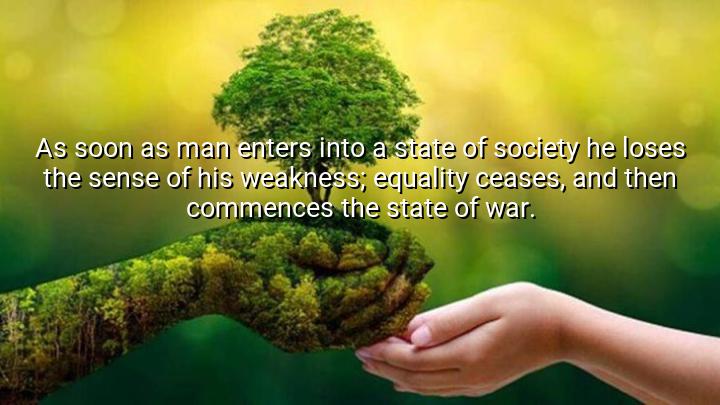




Montesquieu’s quote, “As soon as man enters into a state of society he loses the sense of his weakness; equality ceases, and then commences the state of war,” explores the social contract and the dynamics between individuals and society. Montesquieu, a French political philosopher of the 18th century, is known for his contributions to the understanding of political theory and law, particularly in his seminal work The Spirit of the Laws. In this quote, he reflects on how human nature changes when individuals move from a state of nature into a more structured, societal existence.
Montesquieu suggests that in the natural state, humans are aware of their weakness and vulnerability. However, as they enter society, they gain strength through cooperation, status, and power. This shift in awareness causes equality to dissipate, as individuals gain different levels of power, influence, and resources. In the absence of true equality, Montesquieu argues, competition and inequality begin to emerge, which leads to tensions and conflicts—a "state of war."
The concept of war in this context does not necessarily refer to physical combat but to a broader form of conflict, driven by inequality and competition for power and resources. Montesquieu seems to be arguing that the formation of society and the structures of power within it inevitably create divisions among individuals. Once equality is lost, the human drive for dominance, resources, and status leads to societal discord, undermining the harmony that might have existed in a more egalitarian state.
Ultimately, Montesquieu’s quote highlights the complex relationship between individuals and society. He warns that equality, once disrupted, leads to power struggles and societal instability. His view reflects a broader philosophical concern about the unintended consequences of moving from a natural state of freedom into the structured constraints of organized society.

AAdministratorAdministrator
Welcome, honored guests. Please leave a comment, we will respond soon