

All mankind... being all equal and independent, no one ought to harm another in his life, health, liberty or possessions.
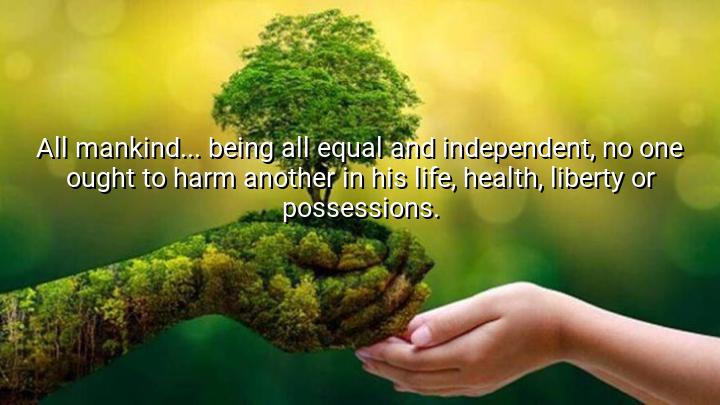




The quote by John Locke, "All mankind... being all equal and independent, no one ought to harm another in his life, health, liberty or possessions," reflects his foundational beliefs in natural rights and the principle of individual freedom. Locke argues that every person is inherently equal and independent, and as such, has the right to live without fear of harm to their life, health, liberty, or possessions. This idea emphasizes the protection of personal autonomy and the importance of respecting the rights of others as essential to maintaining a just society.
Locke's philosophy is rooted in the concept of natural law, which holds that certain rights are inherent to all individuals by virtue of their humanity. These rights—namely life, health, liberty, and property—are not granted by governments but are inalienable and must be protected. His work laid the intellectual foundation for modern concepts of democracy and human rights, influencing later political thought, especially in the formation of constitutional democracies.
As a political philosopher, John Locke was instrumental in shaping Enlightenment ideas on governance and the role of the state. His Second Treatise of Government outlined the argument that the primary role of government is to protect these basic natural rights. Locke’s views on the sanctity of individual rights and the idea that no one should infringe on the freedom of others had a profound impact on the development of liberal political theory.
Ultimately, Locke’s quote underscores the importance of respecting others’ rights and freedom as the basis for a just and peaceful society. By advocating for the protection of life, health, and property, he established the principle that no individual or authority has the right to infringe upon these fundamental aspects of human existence, creating a framework for individual liberty and equality in the modern world.

AAdministratorAdministrator
Welcome, honored guests. Please leave a comment, we will respond soon