

A man growing old becomes a child again.
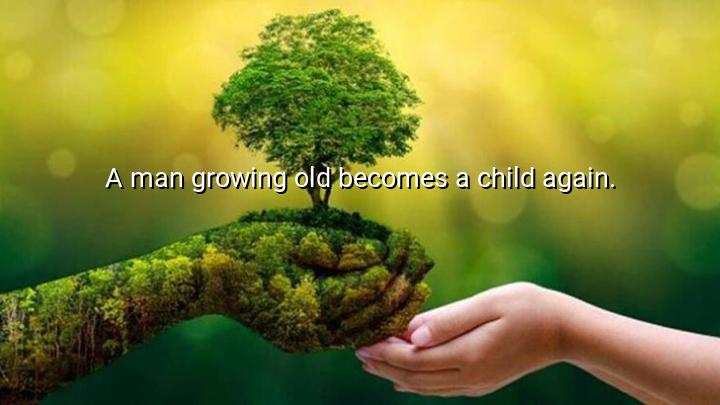




In this quote, Sophocles reflects on the cyclical nature of life, suggesting that as a person grows older, they return to a state of vulnerability and dependence similar to that of childhood. The phrase “becomes a child again” highlights the idea that old age often brings with it a loss of independence and a need for the care and support of others, much like the early stages of life. This return to a child-like state is not just physical but also emotional, as the elderly may find themselves more reliant on the help of others in managing their daily needs.
Sophocles' words draw attention to the fragility that comes with aging. As a man matures, he may gain wisdom and experience, but in his later years, he may experience a reversal of this process. In his old age, he might need help with tasks he once did easily and may become more susceptible to physical or emotional difficulties, much like a child who is still learning to navigate the world. This transformation from independence to dependence is a natural part of the aging process.
The quote also implies a shift in mental and emotional states, where the elderly may exhibit behaviors that are reminiscent of their younger years, such as a simpler approach to life or an increased need for comfort and attention. In childhood, people are often more innocent, direct, and in need of nurturing, and as they age, these traits may resurface in some way, creating a sense of circularity in life.
Ultimately, Sophocles’ quote offers a philosophical reflection on the human condition, reminding us that life’s stages are interconnected. As we age, we may become more like the children we once were, reminding us of the vulnerabilities we all face at different points in life, and the importance of care, compassion, and understanding throughout our journey.

PCphuonganh Channel
I’m conflicted by this quote. On one hand, it speaks to the fragility of aging. On the other, it suggests a cycle of life that ends where it began. But does growing old really make us more like children, or is that just how we’re treated when we become less productive? Maybe the real issue is how society values youth over age—and that's worth questioning.
TMThy Minhthy
If we take this literally, it might sound negative or patronizing. But maybe Sophocles was talking about a softening of the soul, a reawakening of curiosity, or a return to wonder. I’d love to know—can growing old help us reconnect with joy, innocence, or imagination? Or does society’s fear of aging blind us to its potential for personal renewal?
TLBui thi loi
This quote hits me emotionally. It reminds me of my grandfather in his later years—forgetful, playful, and sometimes fragile. But does this return to childlike behavior mean that age strips away who we are, or reveals our truest selves? I wonder how much of our ‘adult’ identity is just a performance that peels away with time. What do others think—is this comforting or unsettling?
HAHa Anh
There’s something both tender and haunting about this idea. It makes me wonder if losing independence in old age forces us to rely on others the way children do. But is that regression—or just a shift in human needs? Maybe it's also about the purity or vulnerability that returns with age. Still, is this view empowering or diminishing for older adults?
NNam
Is Sophocles referring only to physical and mental decline, or is there something deeper—like a return to emotional simplicity or dependence on others? This quote makes me think about how life seems to come full circle. But is it fair to compare old age to childhood? Children are growing and learning, while the elderly are often marginalized. Shouldn’t we be celebrating their wisdom rather than infantilizing them?