

Youth cannot know how age thinks and feels. But old men are guilty if they forget what it was to be young.
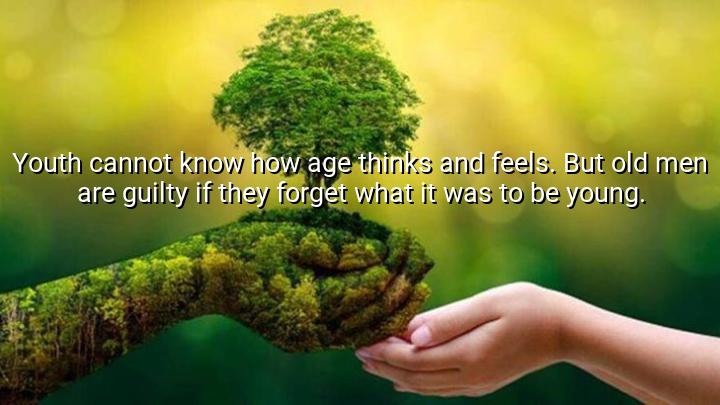




In this quote, J.K. Rowling addresses the generational divide between youth and old age, emphasizing that the experiences and perceptions of each are fundamentally different. She suggests that youth cannot fully understand or relate to the thoughts and feelings of older individuals because they have not yet lived through the complexities and realities of aging. However, she also points out that older men are at fault if they forget what it was like to be young—implying that age should not erase the ability to empathize with younger generations.
Rowling’s words emphasize the importance of empathy across generations. While it’s natural for youth to lack the perspective of age, she believes that as we grow older, it is essential to remember the struggles, dreams, and passions of youth. By forgetting what it was like to be young, older individuals may lose the ability to relate to the challenges faced by younger generations, which can lead to a disconnect or lack of understanding between the two.
The quote also speaks to the importance of reflection in the aging process. Rowling implies that maturity should not result in forgetting one’s youthful experiences but should instead enrich one’s understanding of the complexity of life. When older individuals remember what it was like to be young, they can offer more thoughtful guidance, support, and wisdom to those who are just beginning their journey.
Ultimately, J.K. Rowling's quote encourages a balance between wisdom and empathy. While youth and old age offer different perspectives, it is crucial for the older generation to retain a connection to their past experiences. This connection ensures that they continue to engage meaningfully with younger generations, offering guidance while understanding the difficulties they face.

DTDuc Thinh
There’s something incredibly wise about this quote, but it also feels like a warning. If older people can’t remember what it felt like to be young, they risk alienating the next generation entirely. Could this be part of the reason why so many youth feel misunderstood or unheard by older generations? What practical steps could bridge that empathy gap in families, education, or politics?
VDVo dat
What I find interesting here is the moral undertone—that forgetting one's own youth is not just a lapse, but a kind of guilt or failure. Do you think this is a fair judgment? As people age and take on more responsibilities, isn’t it natural to prioritize caution and forget youthful impulsiveness? Or does doing so risk losing a vital part of humanity and connection?
NHnhug hog
This quote makes me think about how parenting works. So often, parents impose expectations without recalling the confusion or rebellion they once felt as teens. Wouldn't parenting—and mentoring in general—be more effective if it were rooted in remembering rather than just instructing? Is this a call for humility and reflection in leadership roles, especially those guiding youth?
NKNgan Kim
I appreciate the dual perspective in this quote. It acknowledges the natural limitations of youth while also holding the elderly accountable for remembering their own pasts. But how realistic is it for someone in their seventies to truly connect with someone in their teens today, given how much the world has changed? Is emotional memory enough to build that bridge?
TPTan Pham
This quote hits deep. It really makes me think about how easily older generations can become judgmental toward youth, forgetting the mistakes and emotions they once experienced. Isn’t it a bit hypocritical when older people expect young folks to have it all figured out? How can we create more empathy and mutual understanding between generations rather than reinforcing the 'you’ll understand when you're older' mindset?