

Your timeless self does not age and has no fear of the future. Contemplate your physical self and all its possessions, and practice laughing peacefully at it all.
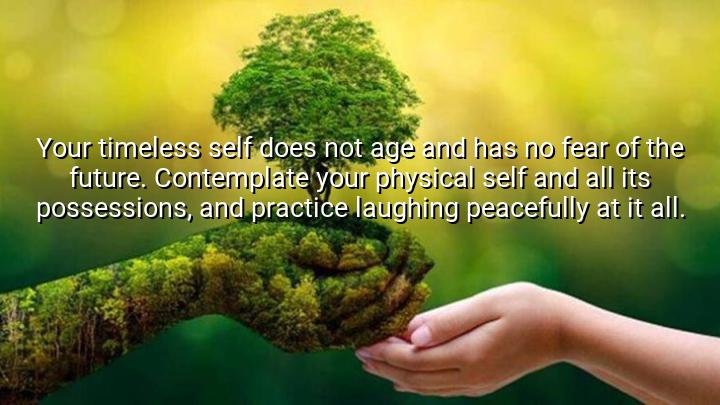




In this quote, Wayne Dyer presents a spiritual perspective on the relationship between the timeless self and the physical self. He suggests that while our physical bodies are subject to aging and the passing of time, our true essence, or timeless self, remains eternal and free from the limitations of age. Dyer encourages individuals to contemplate their physical existence—not with fear or attachment—but with a sense of humor and peace, recognizing that the self beyond the body remains untouched by time.
Dyer emphasizes that the timeless self is not concerned with the future or the inevitable aging process of the body. This part of ourselves, according to Dyer, exists outside of the constraints of time and is free from the anxiety that often accompanies the passage of years. The timeless self is beyond fear and attachment, existing in a state of calm and spiritual freedom, unaffected by the physical changes we experience.
The suggestion to practice laughing peacefully at the physical self and its possessions highlights the importance of detachment from material concerns. Dyer encourages people to let go of the need for possessions or physical beauty, which are transient and impermanent, and instead find peace in accepting the inevitable changes of the body. The act of laughing peacefully symbolizes a lighthearted acceptance of life's fleeting nature, allowing for spiritual growth without being overly preoccupied with physical appearances or material success.
Ultimately, Wayne Dyer’s quote reminds us to cultivate an awareness of the eternal self that exists beyond the physical world. By recognizing that our essence is not tied to the aging process or our material possessions, we can approach life with a sense of inner peace, free from the fears and attachments that often dominate our thoughts. This perspective encourages spiritual growth and acceptance, offering a way to live fully in the present moment.

GDGold D.dragon
I’m intrigued by the concept of laughing peacefully at the physical self and its possessions. Is Dyer advocating for a kind of spiritual humor—a cosmic joke about how seriously we take life? If so, that’s refreshing. But is there a danger in becoming too detached? What happens to ambition, passion, or even love when we stop taking the physical world seriously? Can detachment and engagement coexist meaningfully?
CVKim Chi Vo
This quote feels like both a gentle challenge and a quiet rebellion against consumerism and ego. It invites us to step back from the constant striving and take life a little less seriously. But how do we apply that mindset in a world that constantly measures worth through appearance, productivity, and possessions? Is this message more relevant now than ever—or harder to follow because of how connected we are to everything material?
CGCameron Grace
Reading this makes me wonder: what exactly is the 'timeless self'? Is it our consciousness, our soul, or something else entirely? And if it truly exists beyond time and fear, how do we access it? Is it through mindfulness, faith, or deep inner work? Dyer makes it sound simple—just laugh at the world—but I feel like there's a deeper practice required. Has anyone actually achieved this kind of peace?
KVTran Thi Kieu Vy
I love the idea of a 'timeless self'—it reminds me of meditation and the concept of the inner observer. But I’m curious: is this a universal truth or something that only resonates with people already on a spiritual path? For those struggling with body image, illness, or aging, this perspective could be comforting… or maybe even dismissive. Can spiritual detachment coexist with compassion for the very real struggles of the body?
TQToan quang
Wayne Dyer’s words speak to a kind of spiritual enlightenment that’s hard to reach but deeply appealing. The idea of laughing peacefully at our possessions and ego-driven concerns is refreshing. But does this perspective risk becoming a form of escapism? If we detach too much from the physical world, how do we stay present and engaged in meaningful action—especially when it comes to helping others who suffer in very material ways?